
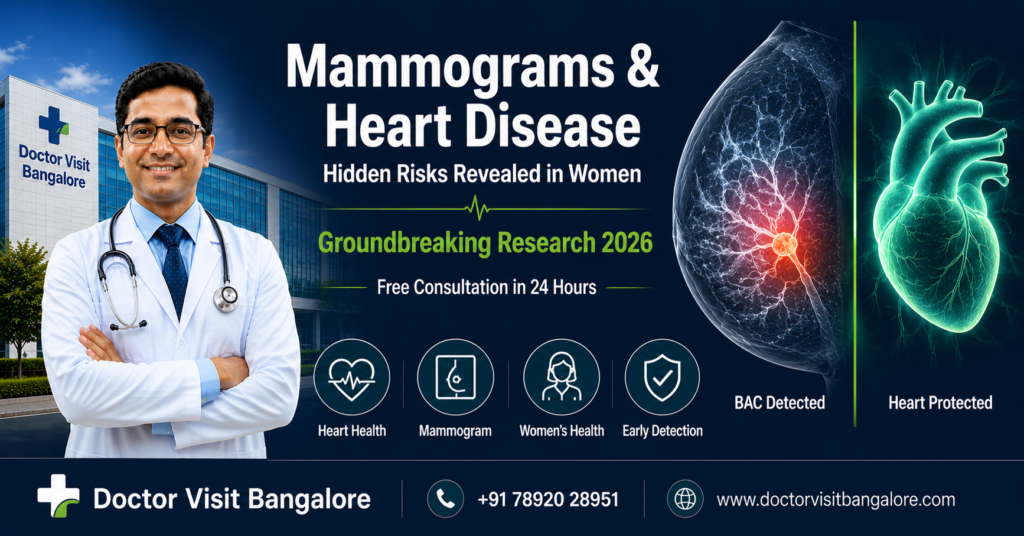
Every year, millions of women in India walk into a clinic for a routine mammogram — a breast X-ray to check for cancer. They go in thinking about one thing: breast health. They come out with their results, relieved or anxious, and move on with their lives.
But what if that same routine mammogram — the one you already do for breast cancer screening — could also give your doctor an early warning about your heart?
That is exactly what groundbreaking new research is revealing. And the implications for women’s health — especially in India, where heart disease is the leading cause of death in women — are enormous.
This blog post explains this exciting discovery in simple terms: what it means, how it works, what Indian women should know, and what steps you can take right now.
The Discovery — What the Research Found
A landmark study published in the European Heart Journal in March 2026 analysed more than 120,000 mammograms from women treated at Emory Healthcare in Atlanta and the Mayo Clinic using artificial intelligence (AI). The findings were striking.
Researchers found that women with the highest levels of calcification had double the risk of major heart problems — including heart attacks, stroke, heart failure and death — compared with women whose scans showed no calcification.
This discovery builds on earlier findings. Research presented at the American Heart Association’s Scientific Sessions showed that BAC was detected through screening mammograms for 1 in 5 women, and twice as many women with BAC experienced a major cardiovascular event within 10 years as those whose mammograms showed no artery calcification.
And in a separate study presented at the 2024 Annual Meeting of The Menopause Society, researchers demonstrated an association between breast arterial calcifications and cardiovascular disease across an 18-year prospective study — one of the longest studies of its kind.
The conclusion from multiple independent research teams across the world is consistent: your mammogram may be able to tell your doctor something critical about your heart — before you have any symptoms at all.
What Is Breast Arterial Calcification (BAC)?
To understand this discovery, you need to understand what breast arterial calcification is — and it is simpler than it sounds.
Your body contains thousands of arteries — the blood vessels that carry oxygen-rich blood from your heart to every part of your body, including your breasts. Over time, in some people, calcium deposits can build up in the walls of these arteries. This is called calcification.
The condition that mammograms can detect is called breast arterial calcification, or BAC. It is relatively common, appearing in an estimated 15% to 25% of screening mammograms.
When a mammogram is taken to screen for breast cancer, the X-ray images also capture these calcium deposits in the breast arteries — they appear as small, thread-like white lines on the image. For decades, radiologists have noticed these deposits on mammograms but largely ignored them — because breast arterial calcification has no known connection to breast cancer.
Despite often being discernible on routine mammograms, radiologists do not typically report the presence of these calcifications because there is no known association between breast arterial calcification and breast cancer.
But the connection to heart disease is a very different story — and that connection is now being taken very seriously by the global medical community.
Why Does Calcium in Breast Arteries Matter for Heart Health?
The presence of calcium in the arteries of the breast is a sign of a broader process happening in the body — a process called arterial stiffening or atherosclerosis (hardening of the arteries).
When arteries throughout the body begin to stiffen and calcify, it significantly increases the risk of:
- Heart attack (myocardial infarction)
- Stroke
- Heart failure
- Death from cardiovascular causes
The calcium deposits visible in the breast arteries on a mammogram are essentially a window into what may be happening in the arteries elsewhere in the body — including the arteries supplying blood to the heart and brain.
BAC is calcium buildup in breast arteries, often identified during routine mammograms. While BAC has been present in imaging for a long time, it has only recently been recognised as a potential cardiovascular risk marker.
Think of it like this: if you can see that the pipes in one part of a building are corroding, it tells you something important about the condition of the pipes throughout the building — even the ones you cannot see directly.
The AI Revolution — How Technology Is Making This Possible
One of the most exciting aspects of this research is the role of artificial intelligence in making this discovery practical and scalable.
In the study published in the European Heart Journal, scientists used artificial intelligence to examine more than 120,000 mammograms. The technology measured calcium deposits in arteries that run through breast tissue.
The AI system sorts the calcium deposits into four categories — ranging from none to severe — with remarkable accuracy and consistency that would be difficult to achieve with human review alone across such large numbers of mammograms.
Automatic quantification of breast arterial calcification on screening mammography can identify women at risk for cardiovascular disease and enable earlier treatment and management of disease.
This means that in the future, the same mammogram image a woman already does for breast cancer screening could be automatically analysed by AI to flag her cardiovascular risk — with no additional radiation, no additional cost, and no additional time.
How Big Is This Risk — The Numbers in Plain Language
The research findings are significant enough to merit serious attention:
| Level of Breast Arterial Calcification | Cardiovascular Risk |
|---|---|
| None | Baseline risk |
| Mild | Modestly elevated |
| Moderate | Significantly elevated |
| Severe | Double the risk of heart attack, stroke, heart failure or death |
In a study of postmenopausal women, 26% had breast arterial calcification, and over a 6½-year study period it was associated with a 23% increased risk of heart disease of any kind and a 51% increase in risk of heart attack or stroke.
The severity and progression of breast arterial calcification predict higher risk, and changes can occur within a year.
Crucially, the research also found that BAC can progress over time — meaning a mammogram done today and again a year later can show whether the calcification is worsening, providing a dynamic picture of cardiovascular risk that current standard tests cannot easily provide.
Why This Matters So Much for Indian Women
Heart disease is often thought of as a “man’s disease” — but this is a dangerous myth. In India, cardiovascular disease is the leading cause of death in women, accounting for approximately one in every three female deaths.
Yet heart disease in women is consistently underdiagnosed and undertreated. The reasons are complex:
Symptoms are different in women. Women having a heart attack often do not experience the classic crushing chest pain that men do. Instead, they may feel extreme fatigue, nausea, jaw pain, or shortness of breath — symptoms that are easily attributed to other causes and often dismissed.
Standard risk tools were developed for men. Most cardiovascular risk calculators used by doctors worldwide were originally developed and validated primarily in male populations. They may underestimate risk in women — particularly younger and middle-aged women.
Women are less likely to be referred for heart investigations. Studies consistently show that women with heart disease symptoms are less likely to be referred for cardiac tests than men with similar symptoms.
Awareness is dropping. A recent report from the American Heart Association shows awareness of heart disease risk among women has been declining in recent years, even as cases increase.
This is precisely why the mammogram-BAC discovery is so significant for Indian women. Mammography is already recommended for Indian women from the age of 40 for breast cancer screening. If BAC reporting becomes standard practice, the same routine test could simultaneously screen for hidden cardiovascular risk — reaching women at the exact moment they are engaged with their healthcare.
What Happens Currently — And What Should Change
Here is the critical gap that researchers are highlighting:
Currently: When a radiologist reads your mammogram, they are looking for signs of breast cancer. If they notice calcium deposits in your breast arteries, they note it — but typically do not report it to you or your doctor, because it is not relevant to breast cancer.
What should change: Researchers from multiple institutions are now calling for breast arterial calcification to be routinely reported on mammogram results, so that the information can be acted upon.
Based on what we found, we believe the presence of breast arterial calcifications on a mammogram should be routinely reported.
The findings suggest the presence of breast artery calcification may even be a better predictor of cardiovascular problems in some women than the currently used risk tool, providing a much-needed opportunity for prevention.
This would allow doctors to use this information to:
- Have a targeted conversation with the patient about cardiovascular risk
- Order appropriate follow-up heart health tests (blood pressure, cholesterol, ECG, echocardiogram)
- Start lifestyle interventions or medical treatment earlier
- Potentially prevent a heart attack or stroke before it happens
Important Caveats — What This Does NOT Mean
While this research is genuinely exciting, it is important to understand its limitations:
BAC is not a definitive diagnosis of heart disease. Finding calcium deposits in breast arteries on a mammogram does not mean you have heart disease or will definitely have a heart attack. It is a risk indicator — one piece of important information among many.
Many cardiac events happen in women WITHOUT BAC. Most cardiovascular events happened to women who did not have breast arterial calcification. So the absence of BAC does not mean you are safe from heart disease.
Mammograms should not replace cardiac screening. Experts are clear that mammograms showing BAC should not replace traditional heart screening tools like blood pressure measurement, cholesterol tests, blood sugar tests, ECG and echocardiograms.
The research is still evolving. While the evidence is growing and compelling, BAC reporting is not yet standard practice in most hospitals in India. This is likely to change in the coming years as the evidence base strengthens and clinical guidelines are updated.
What Indian Women Should Do Right Now
Based on the current evidence, here are the practical steps Indian women can take:
1. Get Your Mammogram — And Ask About BAC
If you are 40 or older, get your routine screening mammogram as recommended. When you receive your report, ask your radiologist or gynaecologist: “Does my mammogram show any breast arterial calcification?” This is a simple, direct question that can open an important conversation.
2. Know Your Heart Disease Risk Factors
Whether or not BAC is reported on your mammogram, every woman should know her cardiovascular risk factors:
- High blood pressure (hypertension)
- High cholesterol (hyperlipidaemia)
- Diabetes or pre-diabetes
- Smoking
- Family history of heart disease
- Obesity
- Physical inactivity
- History of pre-eclampsia or gestational diabetes in pregnancy
3. Get a Comprehensive Heart Check-Up
If you are above 40 — or younger with risk factors — ask your doctor for a comprehensive cardiovascular assessment including blood pressure, fasting blood sugar, lipid profile (cholesterol test), BMI and resting ECG. If any of these are abnormal, further tests like an echocardiogram or stress test may be recommended.
4. Do Not Wait for Symptoms
Heart disease in women is often silent until it is serious. Do not wait for chest pain or breathlessness before taking your heart health seriously. Preventive evaluation is far more effective than emergency treatment.
5. Work With a Cardiologist
If BAC is found on your mammogram, or if you have multiple cardiovascular risk factors, consider seeing a cardiologist proactively — not because you already have heart disease, but because you deserve a proper assessment and a clear prevention plan.
What This Means for the Future of Women’s Healthcare
The potential of this discovery extends far beyond individual patients. If BAC reporting becomes standard practice globally — and in India specifically — it could transform the way heart disease is identified and prevented in women.
Consider the scale: millions of women in India undergo mammograms every year. If each of those mammograms simultaneously screened for cardiovascular risk at no additional cost and no additional radiation — the public health impact could be extraordinary.
Researchers are calling for:
- Standardised BAC reporting protocols for radiologists
- AI integration into mammography systems for automatic BAC quantification
- Clinical guidelines to help doctors act on BAC findings appropriately
- Patient education so women understand what BAC means and does not mean
This is a field that is moving fast. What was an overlooked finding on a routine X-ray just a few years ago is rapidly becoming one of the most promising tools in preventive cardiovascular care for women.
How Doctor Visit Bangalore Can Help
At Doctor Visit Bangalore, we believe that every woman deserves proactive, comprehensive healthcare — not just reactive treatment when something goes wrong.
Whether you need:
- A referral to the best radiologist for a mammogram in Bangalore
- A cardiologist consultation after BAC is found on your mammogram
- A comprehensive women’s heart health check-up
- Guidance on managing cardiovascular risk factors
We are here to help you find the right specialist, at the right hospital, quickly and easily.
✅ Trusted cardiologists and gynaecologists across Bangalore
✅ Mammography centres with advanced imaging technology
✅ Women’s heart health specialists
✅ Quick appointment booking — no long waiting
✅ Support for patients from outside Bangalore and international patients
✅ 24/7 WhatsApp assistance
📞 Call / WhatsApp: +91 78920 28951 🌐 www.doctorvisitbangalore.com
Frequently Asked Questions
Q: If I have already had a mammogram, can I find out if I had BAC? You can request your mammogram images and report from the centre where you were screened. You could then ask a radiologist to look specifically for breast arterial calcification. However, whether this is routinely reported will depend on the specific centre and radiologist.
Q: At what age should Indian women start getting mammograms? The Indian Council of Medical Research (ICMR) and most Indian gynaecological societies recommend that women at average risk begin annual mammography screening from age 40. Women with a family history of breast cancer may be advised to start earlier.
Q: Does finding BAC mean I have blocked arteries in my heart? Not necessarily. BAC is a risk indicator, not a direct measure of coronary artery disease. However, because the same process that causes calcification in breast arteries (atherosclerosis) also occurs in coronary arteries, the presence of BAC warrants further cardiovascular evaluation.
Q: Is BAC testing available in Bangalore? BAC is visible on any standard mammogram — it does not require a special test. The question is whether the radiologist reports it. As awareness of this research grows, more radiology centres and hospitals in Bangalore are likely to begin routinely reporting BAC findings. Asking your radiologist or gynaecologist about it is the first step.
Q: Should I see a cardiologist if BAC is found on my mammogram? Yes — this is a reasonable step. If BAC is found, particularly if it is moderate or severe, a cardiologist can perform a comprehensive cardiovascular risk assessment and advise on prevention or treatment.
Q: Can lifestyle changes reduce BAC? Arterial calcification cannot be fully reversed once it is present, but lifestyle changes — quitting smoking, controlling blood pressure and cholesterol, exercising regularly, maintaining a healthy weight, and managing diabetes — can significantly slow its progression and reduce overall cardiovascular risk.
Final Thoughts — Your Mammogram Could Save Your Life in More Ways Than One
For decades, mammograms have saved lives by detecting breast cancer early. Now, research is showing that the same scan may also be able to save lives by flagging hidden heart disease risk — before any symptoms appear.
This is not about creating fear. It is about using every available tool to protect women’s health. If a routine scan you already do for one reason can also give your doctor life-saving information about your heart — that is a gift worth paying attention to.
The next time you go for your mammogram, ask about BAC. Talk to your doctor about your heart health. Take the steps you need to take.
Because your heart deserves as much attention as your breast health — and now, science is showing us that one scan can help protect both.
Doctor Visit Bangalore is here to help you take that next step.
📞 Call / WhatsApp: +91 78920 28951 🌐 www.doctorvisitbangalore.com
Disclaimer: This article is for informational purposes only and does not constitute medical advice. The research discussed is based on published studies and should not be used as a substitute for professional medical evaluation. Please consult a qualified cardiologist or gynaecologist for personalised advice.

Arman Ali is the founder of Doctor Visit Bangalore, a trusted healthcare navigation platform helping patients find verified doctors, hospitals, and specialists across Bangalore and all over in India. With hands-on experience in healthcare research and patient assistance, Arman has personally helped hundreds of domestic and international patients connect with leading hospitals including Apollo, Manipal, Fortis, and Aster. His content is grounded in real hospital data, treatment cost research, and direct coordination with medical professionals across Bangalore. He specializes in medical tourism guidance, treatment cost transparency, and specialist discovery for complex conditions including cancer, cardiac surgery, and orthopedic care.