
She had been told for years that she had “cysts on her ovaries.”
She changed her diet. She tried to lose weight. She saw three different doctors. None of them agreed on what exactly was wrong or what to do about it. One focused on her periods. Another focused on her weight. A third mentioned her skin.
Nobody ever looked at the whole picture.
That is exactly why — after more than a decade of research, 22,000 patient voices, and a global medical consensus — the condition she was living with has finally been given a name that actually tells the truth.
PCOS is gone. PMOS is here.
And for millions of Indian women, this is the most important medical news of 2026.
What Just Happened? The Big Announcement Explained Simply
On May 12, 2026, a landmark paper was published in The Lancet — one of the most respected medical journals in the world.
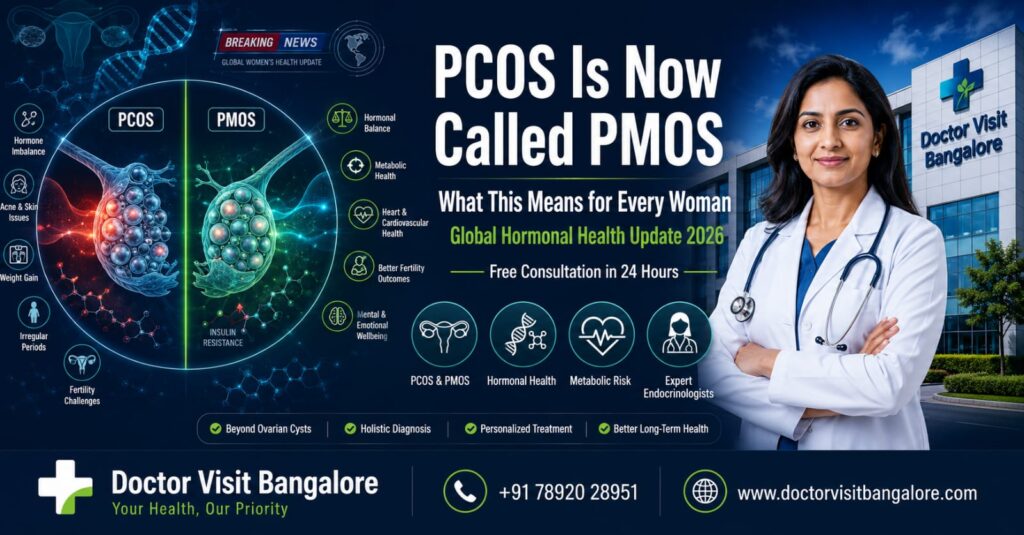
The paper announced that Polycystic Ovary Syndrome (PCOS) has been officially renamed Polyendocrine Metabolic Ovarian Syndrome (PMOS).
This was not a decision made overnight by one doctor in one country. This was the result of a rigorous 11-year global process involving:
- 22,000 patients and healthcare professionals surveyed across every region of the world
- 56 leading academic, clinical and patient organisations
- Modified Delphi methods, international workshops and multiple rounds of global voting
- Final agreement reached in February 2026
- Official announcement at the European Congress of Endocrinology in Prague
The Endocrine Society, the American College of Obstetricians and Gynecologists, and dozens of other major medical bodies all participated. This is as official as medical decisions get.
The old name — PCOS — is now medically retired.
Why Was PCOS a Bad Name? (The Problem Nobody Talked About)
To understand why this matters so much, you need to understand why the old name was causing real harm to real women.
Problem 1 — The “cysts” in PCOS were never the main issue
The name “Polycystic Ovary Syndrome” puts cysts front and centre. But here is the truth that most women — and even many doctors — never fully understood: not every woman with this condition has cysts on her ovaries. In fact, a large number of women diagnosed with PCOS have no visible cysts at all.
This created a devastating cycle. Doctors looked for cysts. If they did not find them, they sometimes dismissed the diagnosis or delayed it. Women suffered longer than necessary. Treatments were delayed.
Problem 2 — The name hid the real complexity
PCOS is not just a problem with ovaries. It is a complex, whole-body condition affecting hormones, metabolism, skin, mental health, weight, heart health, and fertility all at once. The old name made it sound like a plumbing problem. The new name — Polyendocrine Metabolic Ovarian Syndrome — actually tells you what is really happening inside your body.
Problem 3 — The name created stigma
Because the name focused on ovaries and cysts, the condition was repeatedly reduced to “a fertility problem.” Women without fertility concerns were often told they did not need treatment. Their metabolic risks — including diabetes, cardiovascular disease, and mental health conditions — went unaddressed for years.
What Does PMOS Actually Mean? Breaking Down the New Name
Let us decode the new name word by word so you understand exactly what it is telling you:
POLY — Multiple, many There are multiple systems affected. This is not one problem in one place.
ENDOCRINE — Hormones This is fundamentally a hormonal disorder. Your endocrine system — the network of glands that produce hormones — is at the centre of this condition. Insulin, androgens (male hormones), LH, FSH — multiple hormones are dysregulated.
METABOLIC — How your body processes energy PMOS has a profound impact on metabolism. How your body handles sugar, fat, and energy is fundamentally different in women with PMOS. This explains the weight gain, insulin resistance, and increased diabetes risk.
OVARIAN — Connected to the ovaries The ovaries are still involved — the condition still affects ovulation, periods, and fertility. But they are no longer the only focus.
SYNDROME — A collection of symptoms, not one single disease PMOS presents differently in different women. Some have irregular periods. Some have excess hair growth. Some have skin problems. Some have all of these. Some have none but still have hormonal and metabolic dysfunction.
In four words, the new name tells a story that the old name never could.
Why This Hits Indian Women Hardest
This is not just a global story. This is specifically an Indian story.
India has one of the highest rates of PCOS — now PMOS — in the world. Studies estimate that between 10 to 22% of Indian women of reproductive age are affected. That is potentially one in five women in your family, your workplace, your neighbourhood.
And Indian women face a specific biological vulnerability that makes PMOS more dangerous here than almost anywhere else on earth.
The “Asian Indian phenotype” — a term used by medical researchers — describes how South Asian women are genetically predisposed to accumulate more fat around the abdomen even at normal body weight, have higher insulin resistance compared to women of other ethnicities at the same BMI, and develop cardiometabolic complications at lower thresholds than Western populations.
In practical terms: an Indian woman with PMOS can be at serious metabolic risk even if she appears slim and healthy on the outside.
The old name — PCOS — caused Indian doctors to focus on ovaries and fertility. The new name — PMOS — forces a focus on hormones and metabolism. For Indian women, this shift in focus could genuinely be life-changing.
The Symptoms — And Why So Many Women Are Undiagnosed
PMOS is notoriously underdiagnosed. The condition presents differently in every woman, which is part of why doctors historically struggled to identify it quickly.
Here are the full range of symptoms — many of which you will recognise but may not have connected to the same condition:
Menstrual symptoms:
- Irregular periods — cycles shorter than 21 days or longer than 35 days
- Absent periods for months at a time
- Very heavy or very painful periods
- Unpredictable cycle lengths from month to month
Hormonal symptoms:
- Excess facial or body hair — chin, upper lip, chest, stomach (called hirsutism)
- Acne — particularly jawline, chin, and back acne that does not respond to normal treatment
- Scalp hair thinning or loss — particularly at the crown
- Oily skin
Metabolic symptoms:
- Difficulty losing weight despite diet and exercise
- Weight gain that clusters around the abdomen
- Intense sugar cravings
- Energy crashes after eating — particularly after carbohydrate-heavy meals
- Darkening of skin in folds — neck, armpits, groin — called acanthosis nigricans (a sign of insulin resistance)
Reproductive symptoms:
- Difficulty conceiving
- Recurrent miscarriage
- Ovarian cysts — present in some but not all women
Mental health symptoms:
- Anxiety
- Depression
- Low self-esteem connected to physical symptoms
- Brain fog — difficulty concentrating
The critical point: you do not need all of these symptoms to have PMOS. You may have only three or four. You may have different ones at different stages of your life. This is why the syndrome has been so consistently misdiagnosed and undertreated.
The Long-Term Health Risks — What Gets Missed When PMOS Is Not Treated
This is the section that most doctors in India historically skipped — because the old name pointed them toward ovaries, not metabolism and long-term health.
Women with untreated PMOS are at significantly higher risk of:
Type 2 Diabetes Up to 50% of women with PMOS develop Type 2 Diabetes or pre-diabetes by the age of 40. In Indian women, this risk is even higher due to the Asian Indian phenotype and its associated insulin resistance.
Cardiovascular Disease Hormonal imbalance and metabolic dysfunction together damage blood vessels over time. Women with PMOS have higher rates of high blood pressure, high cholesterol, and heart disease.
Endometrial Cancer Irregular or absent periods mean the lining of the uterus builds up without being shed regularly. Over years, this increases the risk of endometrial cancer.
Sleep Apnoea Far more common in women with PMOS than in the general female population — and frequently undiagnosed.
Non-Alcoholic Fatty Liver Disease Insulin resistance drives fat accumulation in the liver, even in women who do not drink alcohol.
Mental Health Conditions Women with PMOS have significantly higher rates of anxiety and depression. For Indian women, where mental health remains heavily stigmatised, these conditions often go completely untreated.
This is why the name change matters. When the name says “metabolic,” doctors are reminded to check for all of these. When the name said “cysts,” many of these were never even looked for.
How Is PMOS Diagnosed?
Diagnosis of PMOS requires a combination of:
Menstrual history review Your doctor will ask detailed questions about your cycle history — irregularity, absence, heaviness.
Blood tests — hormonal panel
- LH and FSH levels
- Testosterone and androgen levels
- Insulin and fasting glucose — critical for metabolic assessment
- Thyroid function — to rule out thyroid conditions that mimic PMOS
- Prolactin levels
Ultrasound A pelvic ultrasound to check the ovaries — but remember, the presence or absence of cysts is now understood to be just one piece of a larger picture, not the defining feature.
Physical examination Assessment of BMI, waist circumference, signs of insulin resistance (skin darkening, skin tags), and signs of excess androgen (hair growth patterns, acne severity).
Who to see in Bangalore: You need both a Gynaecologist and an Endocrinologist — ideally working together. PMOS is a multisystem condition that benefits from a team approach.
Or WhatsApp us and we will connect you with the right specialist for your specific symptoms — free of charge.
How Is PMOS Treated? (The Full Picture)
There is no single cure for PMOS. But it is absolutely manageable — and the earlier it is treated, the better the long-term outcomes. Treatment is tailored to what each individual woman needs most.
If your priority is regulating your cycle and hormones:
- Combined oral contraceptive pills — regulate periods, reduce androgens, improve acne and hair growth
- Progesterone therapy — to protect the uterine lining if periods are very infrequent
If your priority is metabolic health:
- Metformin — an insulin-sensitising medication that reduces insulin resistance, helps with weight management, and lowers diabetes risk. Widely used for PMOS in India.
- Inositol supplements — myo-inositol and D-chiro-inositol have emerging evidence for improving insulin sensitivity in PMOS
If your priority is fertility:
- Letrozole — the first-line medication for inducing ovulation in PMOS
- Clomiphene citrate — also used for ovulation induction
- IVF — for women who do not respond to medication
- Laparoscopic ovarian drilling — a minor surgical procedure that can restore normal ovulation in some women
Lifestyle — the most powerful intervention of all: Even a 5 to 10% reduction in body weight in women who are overweight can dramatically improve hormonal balance, restore regular periods, reduce insulin resistance, and improve fertility. Diet and exercise are not optional add-ons in PMOS treatment — they are core medicine.
Diet guidance for Indian women with PMOS:
- Reduce refined carbohydrates — white rice, maida, sugar
- Increase protein at every meal — dal, eggs, paneer, lean meat
- Add fibre — vegetables, legumes, whole grains
- Reduce highly processed foods
- Time your meals consistently — irregular eating worsens insulin resistance
For skin and hair symptoms:
- Spironolactone — reduces excess androgen effects on skin and hair
- Topical treatments for acne under dermatologist guidance
- Laser hair removal for hirsutism — widely available in Bangalore
What the Name Change Means Practically — For You, Right Now
If you were already diagnosed with PCOS: Your diagnosis is still valid. Nothing about your treatment changes immediately. But expect your doctors to begin referring to your condition as PMOS. Expect updated clinical guidelines over the next 12 to 24 months. Expect broader metabolic screening to become standard in your care.
If you are currently undiagnosed but suspect you have this condition: The name change is being accompanied by updated diagnostic guidelines that are intended to reduce misdiagnosis and delayed diagnosis. This is a good time to seek a formal evaluation — particularly if you have irregular periods, acne, weight gain around the abdomen, or a family history of diabetes.
If you have been told “you do not have PCOS because you have no cysts”: This was one of the most common misdiagnoses under the old criteria. Please seek a second opinion from an endocrinologist or gynaecologist who is aware of the updated PMOS diagnostic criteria.
Frequently Asked Questions
Is PCOS and PMOS the same condition? Yes — completely the same condition. The biology has not changed. Only the name has changed, to more accurately reflect what the condition actually involves.
Do I need to change my medication if I was on PCOS treatment? No. Your current medication does not change because of the name change. Continue your current treatment and discuss the updated guidelines with your doctor at your next appointment.
Why did it take so long to rename it? Medical consensus at a global scale takes time. The process involved 22,000 people across 11 years, with multiple rounds of surveys, expert panels, and international agreement protocols. The goal was to ensure the new name was right — not just faster.
Will Indian doctors start using the new name immediately? It will take time. Name changes in medicine do not happen overnight. Expect a transition period of 1 to 2 years where both PCOS and PMOS are used interchangeably. Official adoption will follow as medical education and clinical guidelines are updated.
Is there a test specifically for PMOS? There is no single test. Diagnosis combines hormonal blood tests, metabolic tests, ultrasound, and clinical assessment. This is why seeing both a gynaecologist and an endocrinologist is ideal.
Can PMOS be cured? Not cured, but very effectively managed. Many women with PMOS lead completely normal, healthy lives with the right treatment and lifestyle approach.
Does PMOS affect fertility permanently? No. Most women with PMOS can conceive — often with medical support. The condition affects ovulation, which can make natural conception more difficult, but fertility treatments have excellent success rates for women with PMOS.
Find the Right Specialist in Bangalore — We Will Help You
Navigating PMOS care in Bangalore does not have to be confusing. At Doctor Visit Bangalore, we help you find verified, experienced specialists who understand the full complexity of PMOS — not just the reproductive aspect, but the hormonal and metabolic picture too.
Recommended specialists for PMOS in Bangalore:
- Gynaecologist in Bangalore — for menstrual regulation and fertility
- Endocrinologist in Bangalore — for hormonal and metabolic management
- Dermatologist in Bangalore — for acne, skin and hair symptoms
📞 Call Us: +91 78920 28951 💬 WhatsApp Us Now
We respond within minutes and connect you with the right doctor — completely free.
Final Word
For decades, millions of women were told they had a problem with their ovaries.
They were dismissed, misdiagnosed, undertreated, and made to feel that their condition was simpler than it was.
The renaming of PCOS to PMOS is not just a change of letters. It is a formal acknowledgement by the global medical community that this condition was never fully understood — and that the women living with it deserved better.
The new name will not fix everything overnight. But it points doctors in the right direction. It demands that metabolism be taken seriously. It demands that hormones be investigated fully. It demands that the whole woman be treated — not just her ovaries.
If you have been living with PCOS — now PMOS — and have ever felt dismissed, underserved, or confused about your diagnosis, this moment belongs to you.
Sources: The Lancet (May 2026), Endocrine Society, STAT News, Time Magazine, Outlook India, National Institutes of Health (NIH) This article follows the Doctor Visit Bangalore Editorial Policy. All content is researched and updated regularly for accuracy.

Arman Ali is the founder of Doctor Visit Bangalore, a trusted healthcare navigation platform helping patients find verified doctors, hospitals, and specialists across Bangalore and all over in India. With hands-on experience in healthcare research and patient assistance, Arman has personally helped hundreds of domestic and international patients connect with leading hospitals including Apollo, Manipal, Fortis, and Aster. His content is grounded in real hospital data, treatment cost research, and direct coordination with medical professionals across Bangalore. He specializes in medical tourism guidance, treatment cost transparency, and specialist discovery for complex conditions including cancer, cardiac surgery, and orthopedic care.