
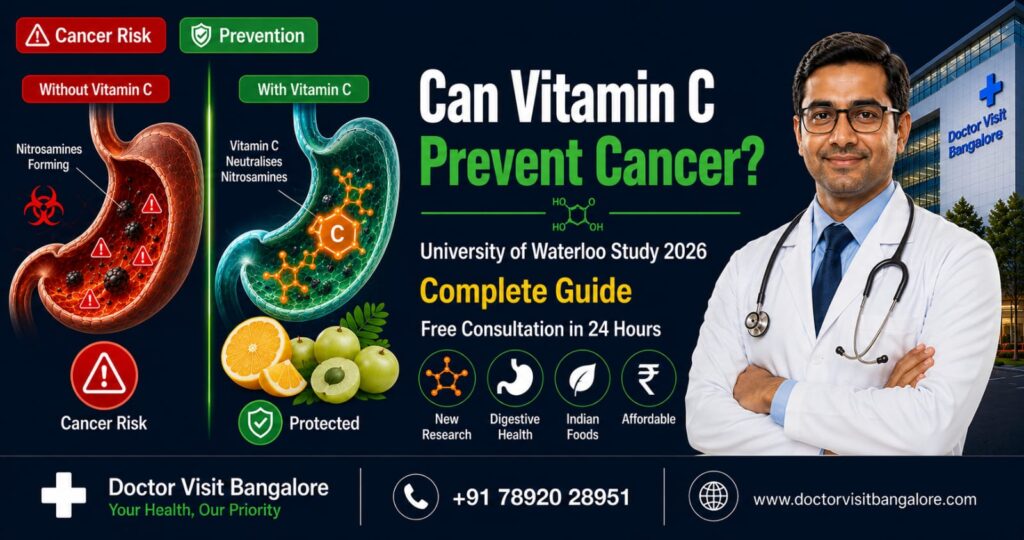
Vitamin C cancer prevention is no longer just a theory — a landmark 2026 study from the University of Waterloo has revealed exactly how Vitamin C blocks the chemical reaction inside your stomach that leads to cancer.
She had been squeezing a glass of orange juice every morning for as long as she could remember.
Her mother had taught her. Her grandmother before that. “Vitamin C keeps you strong,” they said. “It fights illness.” She believed them — the way you believe things that have always been true in your family.
But she never knew why. Not really.
On May 20, 2026, researchers at the University of Waterloo published a study that explains the “why” more clearly than anything that came before it. And what they found does not just explain why that glass of orange juice was a good idea.
It explains why, at a molecular level, Vitamin C might be one of the most powerful tools your body has to block one of the chemical reactions that causes cancer.
This is not a health magazine headline. This is a peer-reviewed mathematical model of exactly what happens inside your stomach when Vitamin C is present — and what happens when it is not.
If you eat processed food, restaurant meals, packaged snacks, or any amount of cured or preserved meat — and that describes virtually every person in urban India today — this research is directly relevant to you.
Vitamin C Cancer Prevention 2026 — What the New Study Found
On May 20, 2026, the University of Waterloo in Canada published a landmark study using advanced mathematical modelling to examine exactly how Vitamin C interacts with cancer-causing chemical reactions inside the human digestive system.
Here is what they found — in plain language:
When you eat certain processed or preserved foods, your stomach becomes a site of a chemical reaction called nitrosation. This reaction converts harmless compounds called nitrates and nitrites into a more dangerous group of chemicals called nitrosamines — compounds that many scientists believe increase cancer risk, particularly for stomach, oesophageal, and colorectal cancer.
The groundbreaking finding of this study is that Vitamin C — when present in your digestive system at the same time as these nitrates and nitrites — can significantly interfere with and slow down this nitrosation reaction. In simple terms: Vitamin C competes with the cancer-causing chemical reaction and wins a significant portion of the time.
As the lead researcher, Dr. Gordon McNicol, a post-doctoral researcher in applied mathematics at the University of Waterloo, explained: “Since at least the 90s, researchers have been studying the link between cancer and these compounds, with conflicting results. Our work suggests that the presence of dietary Vitamin C may help explain these inconsistencies.”
In other words — previous studies gave confusing results about whether nitrates and nitrites cause cancer because they did not account for whether or not people were eating enough Vitamin C at the same time. When Vitamin C is present, the harmful reaction is blocked. When it is not — the reaction proceeds.
This changes how we understand cancer prevention in a fundamental way.
What Are Nitrates and Nitrites? Why Are They in Your Food?
Before we go further, you need to understand what nitrates and nitrites actually are — because most people have never heard of them, yet they are eating them every single day.
Nitrates (NO3) and nitrites (NO2) are naturally occurring chemical compounds containing nitrogen and oxygen. They exist in two very different contexts:
In natural foods — they are beneficial. Leafy green vegetables like spinach, rocket, and coriander contain high concentrations of natural nitrates. Beetroot is famously high in nitrates. These natural nitrates, when consumed from vegetables, are associated with health benefits — particularly for blood pressure, cardiovascular health, and athletic performance. Your body uses them to produce nitric oxide, which relaxes blood vessels.
In processed and preserved foods — the picture changes. Over the last several decades, nitrates and nitrites have been widely used as food preservatives — particularly in cured and processed meats. They prevent bacterial growth, extend shelf life, and give cured meats their characteristic pink colour.
Common sources of nitrates and nitrites in the Indian diet include:
- Processed sausages, salami, and deli meats
- Packaged sandwich meats and ham
- Canned and tinned meats
- Some processed fish products
- Certain pickled and cured foods
- Vegetables grown using fertilizers contaminated with nitrogen compounds from polluted soil and water
The problem is not the nitrates and nitrites themselves in every context. The problem is what happens to them inside your stomach.
What Is Nitrosation? The Hidden Chemical Reaction in Your Stomach
This is the chemistry that most people have never heard of — and the heart of why this study matters.
When nitrites enter your stomach, they encounter an acidic environment and various compounds from your food. Under these conditions, a chemical reaction called nitrosation can occur. This reaction converts nitrites into a group of compounds called N-nitroso compounds, more commonly known as nitrosamines.
Nitrosamines are the problem. They are potent carcinogens in animal studies — meaning they cause cancer in laboratory animals reliably. The link between nitrosamines and human cancer — particularly stomach cancer, oesophageal cancer, and colorectal cancer — has been studied since the 1970s. The evidence has been building for over fifty years.
Here is what makes this even more concerning:
The nitrosation reaction happens automatically and silently inside your stomach every time you eat foods containing nitrites in an acidic environment. You cannot feel it. You cannot see it. It requires no exposure to pollution, no genetic mutation, no unusual circumstances. It is a chemical reaction that happens in the digestive systems of billions of people every single day.
Most of the time, your body handles it. But over years and decades of repeated exposure — especially in people with low Vitamin C intake — it may accumulate into meaningful cancer risk.
This is why stomach cancer rates are higher in populations that consume large amounts of processed and cured meats. This is why countries with the highest processed meat consumption historically also have higher rates of stomach and colorectal cancer.
And this is exactly why the University of Waterloo study is so important — because it identifies a specific, measurable way to interrupt this process.
Why India Has a Specific Problem with This
You might be thinking — this study is from Canada, and it talks about North American diets with cured meats. Does it apply to India?
The answer is: more than you might think.
Urban India’s diet is changing fast. A decade ago, the average Indian household rarely ate processed meat. Today, the growth of quick service restaurants, frozen food sections in supermarkets, packaged sandwich counters, and food delivery apps means that processed meat consumption in Indian cities has grown significantly. Bangalore, Mumbai, Delhi, and Chennai are seeing the largest shifts.
Indian vegetables are grown in increasingly polluted conditions. Nitrate contamination of groundwater used for irrigation — from nitrogen-based fertilizers and industrial runoff — is a documented and growing problem across Indian agricultural regions. Vegetables grown in nitrate-contaminated soil and water carry higher nitrate loads than organically grown produce.
India’s stomach cancer burden is significant. Stomach cancer is among the top five cancers in certain regions of India, particularly in the southern and northeastern states. While multiple factors contribute, diet — including processed food exposure and low antioxidant intake in some populations — is one of them.
Vitamin C intake is uneven across Indian populations. While India is a land of fresh produce, urban dietary patterns increasingly involve processed, packaged, and restaurant food with lower fresh fruit and vegetable content than traditional diets. People who eat most of their meals from canteens, delivery apps, or packaged foods may have surprisingly low Vitamin C intake.
The intersection of increasing processed food consumption, agricultural nitrate contamination, and variable Vitamin C intake makes the University of Waterloo findings directly and immediately relevant to urban Indians in 2026.
How Vitamin C Blocks the Cancer Reaction — The Science
The science behind vitamin C cancer prevention 2026 research is surprisingly elegant.
Vitamin C — or ascorbic acid — is a powerful antioxidant and reducing agent. This means it readily donates electrons in chemical reactions. And it turns out that the nitrosation reaction — the conversion of nitrites into nitrosamines — requires a chemical that Vitamin C is very good at neutralising.
The University of Waterloo researchers used mathematical modelling to simulate exactly what happens inside the stomach when different amounts of Vitamin C are present alongside nitrites from food.
What their model revealed is that Vitamin C essentially competes with the nitrosation reaction for the same chemical intermediate. When Vitamin C is present in sufficient concentration, it reacts with the nitrosating agent before that agent can react with amino compounds to form nitrosamines. Vitamin C wins the competition — and the nitrosamine never forms.
When Vitamin C is absent or at low concentrations — the nitrosation reaction proceeds largely unopposed, and nitrosamines form.
The key word in Dr. McNicol’s statement is “timing.” He noted: “Our work suggests that the presence of dietary Vitamin C may help explain these inconsistencies.” This refers to why decades of studies on nitrates, nitrites, and cancer produced contradictory results — because none of them consistently measured what people were eating alongside the nitrates. When people ate vitamin C-rich foods at the same meal, nitrosamine formation was blocked. When they did not — it proceeded.
This is why eating a burger with a slice of tomato is meaningfully different from eating one without it. This is why a meal of processed sausage with a fresh salsa is chemically different from the same sausage without it. The timing of Vitamin C intake with nitrate-containing foods matters enormously.
What Does This Mean Practically? Should You Take Supplements?
Here is where we have to be careful — and honest.
The University of Waterloo study establishes a compelling mathematical model of how Vitamin C interferes with nitrosation chemistry. It is a significant and important piece of research. But it is a modelling study — not a clinical trial. It tells us what should happen based on chemistry. It does not yet prove that taking Vitamin C supplements reduces cancer rates in humans in the long term.
That distinction matters.
What the evidence does support:
Eating foods naturally rich in Vitamin C alongside or shortly after nitrate-containing meals appears to be a sensible, evidence-grounded strategy for reducing nitrosamine formation in the stomach. This is consistent with decades of epidemiological evidence showing that people who eat more fresh fruits and vegetables have lower rates of stomach and colorectal cancer — now with a much clearer chemical explanation for why.
On supplements specifically:
The evidence for Vitamin C supplements reducing cancer risk is less clear than the evidence for dietary Vitamin C from whole foods. This is partly because Vitamin C in supplement form is absorbed and metabolised differently from Vitamin C in food. At high oral doses, absorption decreases significantly — meaning more does not always mean better.
However, if your diet is genuinely low in fresh fruits and vegetables — which applies to many urban Indians eating primarily packaged and restaurant food — a modest daily Vitamin C supplement is inexpensive, widely safe, and consistent with the evidence. A supplement costing as little as 4 pence per tablet in the UK context covered in some reports — available for similarly modest amounts in India — is a reasonable consideration.
The most important practical takeaway:
Eat a source of Vitamin C with every meal that contains processed or cured meat, packaged food, or any food likely to be high in nitrates and nitrites. This does not require supplements. It requires awareness.
A fresh tomato alongside your meal. A glass of fresh lime water. A piece of guava with your snack. A serving of green leafy vegetables. These are not just general health advice — they are, based on this research, a specific, biochemically grounded strategy for reducing one of the chemical pathways that contributes to cancer risk.
The Best Indian Foods Rich in Vitamin C
The good news is that India has some of the most Vitamin C-rich foods in the world — and many of them are common, cheap, and available everywhere.
Here are the best sources ranked by Vitamin C content, with specific guidance on how to include them in a typical Indian diet:
🥇 Amla (Indian Gooseberry) — The Undisputed Champion Amla contains approximately 600–700 mg of Vitamin C per 100 grams — making it one of the richest sources of Vitamin C on the planet. A single fresh amla provides more Vitamin C than several oranges. Raw amla, amla pickle, amla juice, and amla powder (available in any pharmacy or health shop) are all excellent. Amla is also relatively heat-stable, meaning its Vitamin C survives cooking better than many other sources.
🥈 Guava One medium guava contains approximately 200–300 mg of Vitamin C — more than three times the daily recommended intake in a single fruit. Widely available, inexpensive, and delicious. Eat the skin too — it contains a significant portion of the Vitamin C content.
🥉 Capsicum / Bell Pepper (Especially Red and Yellow) Red capsicum contains approximately 190 mg of Vitamin C per 100 grams — more than most citrus fruits. Add sliced capsicum raw to salads, sandwiches, or as a side. Red capsicum in a stir-fry, added at the end to preserve Vitamin C content, is one of the simplest ways to boost intake.
Other Excellent Sources Commonly Available in India:
- Fresh lemon and lime juice — approximately 40–50 mg per lemon, but used in such quantity in Indian cooking that cumulative intake is significant
- Oranges and sweet lime (mosambi) — approximately 60 mg per fruit
- Fresh coriander (dhaniya) — surprisingly high in Vitamin C; used as a garnish in most Indian meals, which is excellent
- Curry leaves — contain Vitamin C and are used daily in South Indian cooking
- Tomatoes — approximately 20 mg per medium tomato; eating one or two per day adds up
- Cauliflower (especially raw or lightly cooked) — approximately 50 mg per 100 grams
- Moringa (drumstick leaves / sahjan) — extremely nutritious and Vitamin C-rich
- Papaya — one cup of raw papaya provides approximately 90 mg of Vitamin C
Important note on cooking: Vitamin C is destroyed by heat. The longer you cook a food, and the higher the temperature, the more Vitamin C is lost. Foods that are boiled for extended periods or fried at high temperatures lose most of their Vitamin C content. To maximise Vitamin C from vegetables, eat some raw or lightly cooked. Add lemon juice at the end of cooking, not during. Eat fresh coriander as a garnish — do not cook it in.
How Much Vitamin C Do You Actually Need?
The official recommendation from the Indian Council of Medical Research (ICMR) is 40 mg of Vitamin C per day for adults — a relatively modest figure that most people with a reasonable diet can meet through food alone.
The WHO recommendation is 45 mg per day for adults.
Many nutrition researchers argue that optimal health — including cancer prevention benefits — may require somewhat more than these minimum figures. Some suggest 100–200 mg per day as a more optimal intake level for adults. This is still achievable through diet without supplements for most people.
Signs your Vitamin C intake may be adequate:
- You eat at least 2 servings of fresh fruits and 3 servings of vegetables daily
- You include raw salad or fresh coriander/lemon in most meals
- You eat fresh guava, amla, or citrus fruit regularly
Signs your Vitamin C intake may be low:
- You eat primarily restaurant, delivery, or packaged food most days
- You rarely eat fresh fruits and vegetables
- You frequently eat meals of rice, dal, and cooked vegetables without fresh salad or garnish
- You smoke (smoking significantly increases Vitamin C requirements)
For most people in India, the goal should be dietary Vitamin C from whole foods — not supplements. However, if your diet is consistently low in fresh produce, a daily supplement of 100–500 mg of Vitamin C is safe, inexpensive, and sensible. Anything above 1000 mg per day should be discussed with a doctor, as very high doses can cause digestive side effects and kidney stones in susceptible individuals.
What the Research Does NOT Say — Important Cautions
In the excitement of a breakthrough study, it is easy to make claims that go beyond what the evidence actually supports. We want to be clear about what this research does and does not mean.
This research does NOT mean:
- That Vitamin C cures cancer
- That taking Vitamin C supplements will prevent cancer in people who already have it
- That you can safely eat unlimited processed meat as long as you take Vitamin C tablets
- That Vitamin C is a cancer treatment that replaces chemotherapy, surgery, or radiation
- That simply eating more oranges will definitively prevent cancer
What this research DOES mean:
- There is a specific, chemically plausible mechanism by which dietary Vitamin C reduces the formation of cancer-associated compounds in the stomach
- This mechanism is consistent with decades of epidemiological data showing lower cancer rates in populations with higher fresh fruit and vegetable consumption
- The timing of Vitamin C intake relative to nitrate-containing foods may be as important as the total amount consumed
- A diet consistently rich in fresh fruits and vegetables is, based on multiple lines of evidence, protective against several cancers
Cancer is complex. No single nutrient prevents all cancers. No single dietary change eliminates cancer risk. The factors that contribute to cancer include genetics, environment, lifestyle, infection, inflammation, and chance — as well as diet. Vitamin C is one important piece of a much larger picture.
The Bigger Picture — Can Diet Really Prevent Cancer?
Vitamin C cancer prevention in 2026 is now backed by one of the clearest mechanistic studies ever published on the topic. This is a question that deserves a straight, honest answer.
Yes — diet is one of the most significant modifiable risk factors for cancer. The World Cancer Research Fund estimates that approximately 30 to 40% of all cancer cases globally are linked to diet, nutrition, and physical activity factors that we can change.
This does not mean that everyone who eats poorly will get cancer, or that everyone who eats well will not. Cancer involves multiple interacting factors. But at a population level, the evidence that dietary choices significantly affect cancer risk is overwhelming and consistent.
The specific cancers most strongly linked to diet include:
- Stomach cancer — strongly linked to processed and preserved food, salt, and low fresh vegetable intake
- Colorectal cancer — linked to processed meat, low fibre, and low fruit and vegetable intake
- Oesophageal cancer — linked to hot foods, alcohol, and low vitamin intake
- Liver cancer — linked to aflatoxin-contaminated food and alcohol
- Oral cavity cancer — linked to tobacco, areca nut (supari), and alcohol; very high rate in India
For Indians specifically, the combination of rising processed food consumption, declining traditional vegetable-rich diets in urban populations, high rates of tobacco and areca nut use, and some Helicobacter pylori infection rates that increase stomach cancer risk — means that dietary cancer prevention strategies deserve serious attention.
The University of Waterloo’s Vitamin C finding is one piece of this picture. But it is a well-researched, mechanistically sound, and practically actionable piece. It gives a specific, science-backed reason to make sure Vitamin C is present at every meal.
Signs You May Be Vitamin C Deficient
Severe Vitamin C deficiency — called scurvy — is rare in India today. But subclinical deficiency (levels lower than optimal without obvious symptoms) is more common than most people realise, particularly in urban populations eating primarily processed food.
Signs that your Vitamin C intake may be below optimal:
Physical signs:
- Slow wound healing — cuts and scrapes that take unusually long to heal
- Gums that bleed easily when brushing
- Easy bruising without significant injury
- Dry, rough, or bumpy skin
- Hair that is dry, coiling, or breaking easily
- Joint pain or swelling
General signs:
- Frequent infections — colds, flu, and minor infections more often than expected
- Fatigue and low energy
- Poor mood — Vitamin C is involved in the production of certain neurotransmitters
Who is most at risk of low Vitamin C in India:
- People eating primarily hotel, canteen, or delivery food
- Heavy smokers — each cigarette destroys approximately 25mg of Vitamin C
- People with chronic digestive conditions that affect nutrient absorption
- Elderly people with reduced appetite and variety in diet
- People under extreme chronic stress (stress increases Vitamin C requirements)
If you have several of these signs and eat a diet low in fresh produce, a conversation with your doctor about checking Vitamin C status is worth having.
When to See an Oncologist in Bangalore
Diet and Vitamin C are prevention strategies — not treatments. If you have any of the following, please see a specialist immediately:
Symptoms that need urgent evaluation:
- Unexplained and persistent stomach pain or discomfort lasting more than 2 weeks
- Difficulty swallowing, or a feeling of food sticking in the throat
- Blood in your stool — red or very dark black stools
- Unexplained weight loss without trying
- Persistent nausea or vomiting
- A lump or swelling anywhere in the abdomen
- Persistent heartburn or acid reflux that does not respond to standard treatment
These are NOT normal digestive symptoms. They may have simple explanations — but they can also be early signs of stomach, colorectal, or oesophageal cancer. Early detection dramatically improves outcomes. Please do not ignore them.
At Doctor Visit Bangalore, we connect you immediately with verified oncologists and gastroenterologists at Bangalore’s leading hospitals — including Apollo, Manipal, Fortis, Aster CMI, and HCG Cancer Hospital.
📞 Call Us: +91 78920 28951 💬 WhatsApp Us Now
We respond within minutes and connect you with the right specialist — completely free of charge.
Frequently Asked Questions
Is this study proof that Vitamin C prevents cancer? It is strong evidence for a specific mechanism — how Vitamin C blocks a chemical reaction in the stomach that produces cancer-associated compounds. It adds to a large body of existing research supporting Vitamin C’s protective role. But it is a modelling study, not a final clinical proof. Think of it as a very significant scientific step forward in understanding, not a finished answer.
Should I take Vitamin C supplements? For most people with a reasonably varied diet, dietary Vitamin C from food is preferred over supplements. If your diet is genuinely low in fresh fruits and vegetables, a modest daily supplement (100–500 mg) is safe and reasonable. Always discuss long-term supplementation with your doctor.
Does cooking destroy Vitamin C? Yes — heat significantly reduces Vitamin C content. The longer and hotter the cooking, the more is lost. To maximise Vitamin C intake, eat some raw fruits and vegetables daily, use lemon juice as a garnish rather than cooking it, and add fresh coriander to finished dishes rather than cooking it in.
Is amla the best source of Vitamin C? Among commonly available Indian foods, yes — amla is extraordinarily rich in Vitamin C. One fresh amla contains more Vitamin C than several oranges. Amla is also relatively heat-stable. If you eat one amla daily, your Vitamin C needs are likely met without any supplement.
Does Vitamin C help if I already have cancer? There is some research on high-dose intravenous Vitamin C as an adjunct to cancer treatment — this is different from oral supplements. If you or a family member has cancer, treatment decisions should always be made by your oncologist. Do not substitute dietary changes for cancer treatment.
Does this mean processed meat is safe if I eat Vitamin C with it? No. Processed meat consumption is linked to cancer risk through multiple mechanisms — not only nitrosamine formation. The WHO’s International Agency for Research on Cancer (IARC) classifies processed meat as a Group 1 carcinogen. Eating Vitamin C alongside it may reduce one specific risk pathway, but it does not make processed meat safe for regular consumption.
What is the best way to eat for cancer prevention in India? A traditional Indian diet — rich in fresh vegetables, legumes, spices, whole grains, and fresh fruit — is one of the most cancer-protective dietary patterns studied. The drift away from this toward urban processed food diets is the primary concern. Returning to more traditional food patterns, supplemented with awareness about specific cancer-prevention strategies like Vitamin C timing, is the most evidence-based approach.
Final Word
She is still squeezing that glass of orange juice every morning.
But now she knows exactly why it matters.
The University of Waterloo study is a reminder of something that feels counterintuitive in an age of expensive supplements, complex health protocols, and advanced medical treatments: some of the most powerful tools for health are the simplest ones, with the deepest roots.
Fresh fruit. Vegetables with every meal. A squeeze of lemon on your food. A piece of guava with your afternoon snack. An amla in your morning routine.
These are not old-fashioned habits. They are, as we now understand more clearly than ever, precise biochemical interventions in one of the pathways that leads to cancer.
You do not need a prescription for any of them.
Sources: University of Waterloo study via News-Medical.net (May 20, 2026) | Bioengineer.org | ScienceBlog.com | RSVP Live | PubMed — Inhibitors of endogenous nitrosation | PubMed — Circulating Vitamin C and digestive system cancers | WHO Cancer Prevention | Indian Council of Medical Research (ICMR). This article follows the Doctor Visit Bangalore Editorial Policy. All content is originally written, thoroughly researched, and regularly updated.

Arman Ali is the founder of Doctor Visit Bangalore, a trusted healthcare navigation platform helping patients find verified doctors, hospitals, and specialists across Bangalore and all over in India. With hands-on experience in healthcare research and patient assistance, Arman has personally helped hundreds of domestic and international patients connect with leading hospitals including Apollo, Manipal, Fortis, and Aster. His content is grounded in real hospital data, treatment cost research, and direct coordination with medical professionals across Bangalore. He specializes in medical tourism guidance, treatment cost transparency, and specialist discovery for complex conditions including cancer, cardiac surgery, and orthopedic care.