
She read the headline and immediately called her husband.
“Google is releasing millions of mosquitoes. Is this real?”
It is real. And the story is far more fascinating — and far more important to your health — than any headline can capture.
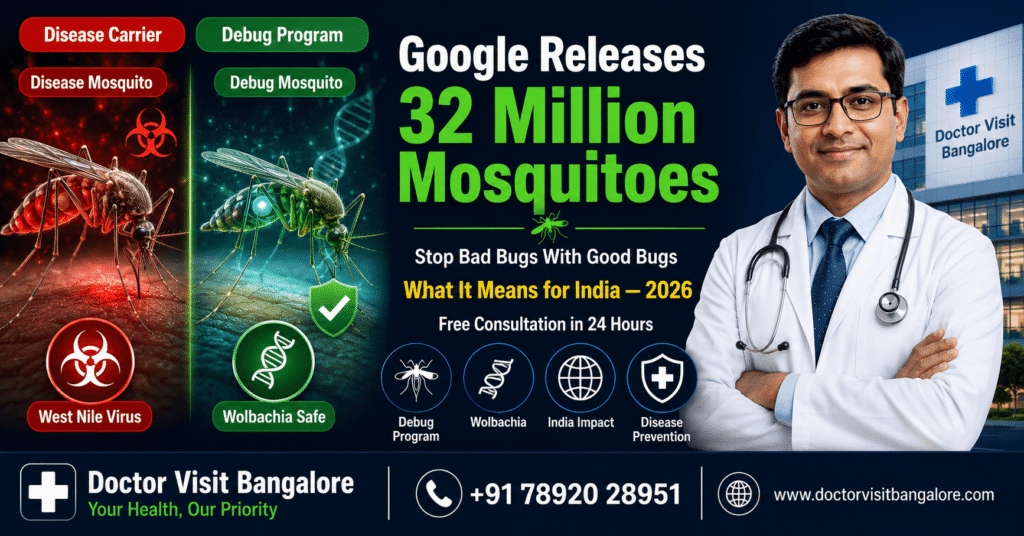
This week, Google’s parent company Alphabet confirmed that its life sciences wing, Verily, has submitted a proposal to the United States Environmental Protection Agency to release up to 32 million lab-bred mosquitoes across California and Florida over the next two years.
The internet responded with a mixture of alarm, confusion, and dark humour. “Great — now Google is trying to debug the outdoors.”
But buried beneath the headlines is a genuine scientific breakthrough that has been a decade in the making — and a strategy that could one day protect hundreds of millions of people from some of the world’s most dangerous diseases, including diseases that kill thousands of Indians every single year.
Here is everything you actually need to know.
What Is Google Actually Doing?
Let us start with the facts — because the headlines have been confusing a lot of people.
Google’s plan is part of a project called Debug, developed by Verily — Google’s parent firm Alphabet’s life sciences arm. The company is currently waiting on federal approval to take it forward. The pitch, in the project’s own words, is to “stop bad bugs with good bugs.”
Alphabet is moving forward with an ambitious proposal to release up to 32 million lab-bred male mosquitoes across California and Florida over the next two years. While earlier Debug field trials in California’s Central Valley focused on Aedes aegypti mosquitoes to combat tropical threats like Zika and Dengue, this new 2026 expansion explicitly shifts its focus. The current proposal targets invasive Culex quinquefasciatus mosquitoes, which thrive near urban environments and serve as primary vectors for West Nile virus.
If approved, the project would release up to 16 million mosquitoes in each state annually over two years.
Here is the critical thing most headlines are getting wrong:
These mosquitoes do not bite. They cannot spread disease.
They are all male. Male mosquitoes feed on nectar — not blood. Only female mosquitoes bite. The males being released are completely harmless to humans. Their only purpose is to mate with wild female mosquitoes — and prevent their eggs from hatching.
What Is Wolbachia — And Why Does It Matter?
The secret weapon in this entire plan is not the mosquitoes. It is a microscopic bacterium called Wolbachia pipientis.
The Google Debug webpage explains it this way: “Good bugs are the same species of mosquito as the bad bugs that spread disease. Our good bugs are male mosquitoes that have a naturally-occurring bacteria called Wolbachia which makes them unable to have offspring with wild female mosquitoes. Male mosquitoes can’t bite or spread disease, so good bugs will stop bad ones from reproducing. Over time, there will be fewer and fewer bad mosquitoes.”
The Google Debug scientists emphasise: “This technique uses a naturally occurring bacteria and uses no chemicals, no toxins and doesn’t involve genetic modification. Similar approaches have been used to safely combat other pests for decades.”
Here is how Wolbachia works in simple terms:
Wolbachia is a bacterium that naturally lives inside many insects. About 40 to 60 percent of all insect species on earth already carry some form of Wolbachia — it is not a lab creation. However, different strains of Wolbachia are incompatible with each other.
When a male mosquito carrying one strain of Wolbachia mates with a wild female mosquito that does not carry the same strain, something remarkable happens: the fertilised eggs simply fail to develop. They never hatch. The female’s reproductive effort is entirely wasted. And if this happens at large enough scale — releasing enough males that most wild females mate with Wolbachia-infected males rather than normal males — the mosquito population crashes over successive generations.
No poison. No genetic modification. No lasting environmental chemical contamination. Just biology working against itself.
The Deadliest Animal on Earth — Why Mosquitoes Are a Global Crisis
Before we go further, we need to understand why anyone would spend a decade and enormous resources to solve what sounds like a simple pest problem.
The CDC counts mosquitoes as the deadliest animal on the planet.
Not sharks. Not lions. Not snakes. Mosquitoes.
Every year, mosquitoes are responsible for more than 700,000 human deaths globally through the diseases they carry. This is more deaths than any other animal causes — more than all wars combined in many years.
The diseases they transmit include:
- Malaria — 619,000 deaths per year globally
- Dengue — infects 400 million people per year
- West Nile virus — the most common mosquito-borne disease in the United States
- Zika — linked to severe birth defects
- Chikungunya — causes debilitating joint pain
- Japanese Encephalitis — a serious brain infection common in Asia
- Filariasis (Elephantiasis) — a parasitic disease causing permanent disfigurement
As Google Debug wrote on its project homepage: “Most mosquito-borne diseases don’t have a reliable vaccine or treatment. Attacking mosquitoes with pesticides is unsustainable because they’re becoming less effective over time and can be toxic, and clearing standing water is not enough because people can never find all the places that mosquitoes breed. We need a new approach.”
This is the context. This is why Google — a technology company — decided that solving the mosquito problem was worth a decade of research, billions in funding, and a proposal to release 32 million insects into American cities.
What Is Google’s Debug Program?
Alphabet Inc’s life sciences wing, Verily, has been breeding “good” mosquitoes for the past 10 years under its Debug programme. It is finally ready to release them in the US.
Verily launched its Debug initiative in 2016 to develop technologies aimed at controlling disease-carrying mosquito populations.
The Debug program is not a sudden announcement. It is the culmination of a decade of scientific work, field trials, technological development, and regulatory preparation.
The program had several phases:
Phase 1 — Laboratory development (2016–2018) Verily scientists developed the methods to breed Wolbachia-infected male mosquitoes at large scale — a technically difficult challenge since natural mosquito breeding produces roughly equal numbers of males and females, and releasing females would defeat the entire purpose.
Phase 2 — Debug Fresno pilot (2017–2019) The first real-world test. Verily released sterile male mosquitoes in Fresno, California — a city with a significant Aedes aegypti mosquito problem. The results showed meaningful reduction in local mosquito populations. It proved the concept could work outside the laboratory.
Phase 3 — Technology scaling (2019–2025) Building automated systems capable of producing and releasing mosquitoes at the millions-per-week scale needed for a real public health impact. This is where the AI came in.
Phase 4 — 2026 EPA Proposal The current stage. A full-scale proposal to release up to 32 million mosquitoes across two US states over two years. The company has submitted its plan to the US Environmental Protection Agency under an experimental use permit currently under review. Public comments on the proposal remain open through early June.
How Does the 32 Million Mosquito Plan Actually Work?
Let us walk through exactly what will happen if the EPA approves this proposal.
Step 1 — Mass breeding in controlled facilities Verily’s automated facilities breed Culex quinquefasciatus mosquitoes infected with the Wolbachia wAlbB strain in enormous numbers. These are kept in controlled conditions until ready for release.
Step 2 — AI-powered sex sorting This is the most technically demanding part of the entire operation. Large-scale releases require accurately separating males from females on an industrial scale. If females are released together, safety issues could arise.
Male and female mosquito pupae are slightly different in size — females are marginally larger. Verily’s AI-powered sorting systems use high-resolution imaging and machine learning to identify and separate males from females with very high accuracy. Any female that slips through would undermine the program — and potentially cause harm.
Step 3 — Timed releases Verily plans to use artificial intelligence-powered mosquito sorting systems, automated breeding technology, and specialized release platforms to support the large-scale operation. Mosquitoes are released in specific locations at specific times — typically in the early morning or evening when wild mosquitoes are most active and mating activity is highest.
Step 4 — Wild female mating Released males move into the environment and compete with wild males to mate with wild females. Because there are far more Wolbachia-infected males than normal males, most wild females end up mating with the Verily-bred males.
Step 5 — Population crash When Wolbachia-infected males mate with wild females not carrying the same Wolbachia strain, the resulting eggs fail to hatch. Over successive generations — typically three to four mosquito generations, which happen rapidly — the wild population declines significantly.
Step 6 — Repeat releases The suppression approach requires continual application, almost like the application of insecticide. Unlike some other Wolbachia strategies, this approach requires ongoing releases to maintain the population suppression effect.
The AI Technology Behind It — Why This Is Not Just About Mosquitoes
Something important is being missed in most media coverage of this story.
The industry assesses that the core of this project lies not in the mosquitoes themselves but in AI and automation systems.
Think about what it actually takes to raise, sort, and release 16 million mosquitoes per state per year. That is roughly 300,000 mosquitoes per week — in each state. Every one of them must be:
- Raised in controlled conditions
- Fed and maintained at precise life-stage timing
- Sorted by sex with extremely high accuracy
- Packaged for release
- Released at the right location, time, and density
No human workforce could do this at scale. The entire system depends on automated breeding chambers with precise temperature and humidity control, computer vision systems that can distinguish male from female mosquito pupae by size differentials of fractions of a millimetre, machine learning models that predict optimal release locations and timing based on wild mosquito population data and environmental conditions, and drone and vehicle-based release systems that distribute mosquitoes evenly across target zones.
This is, in many ways, as much a story about applied AI in public health as it is about mosquitoes. And the implications extend far beyond this single project.
Has This Been Done Before? What Singapore Already Proved
The question most people are asking is: has this ever worked at real-world scale?
Yes. Previous Wolbachia-based mosquito control programs in locations including Singapore and parts of Florida have reported reductions in mosquito populations.
Singapore’s experience is particularly relevant. The National Environment Agency of Singapore has been running a Wolbachia mosquito release program since 2016 — initially as a pilot in three housing estates, then progressively expanded across the island.
By 2023, Singapore reported dengue mosquito population reductions of up to 88% in areas where the program had been running consistently. Dengue case counts in those areas fell dramatically.
In all of the locations around the world where Wolbachia has been established, local transmission of the dengue virus, in particular, has stopped completely in some cases.
This is not a theoretical concept. Singapore proved it works at city scale. Brazil, Australia, Vietnam, and Colombia have all run similar programs with meaningful results.
The 2026 Google proposal is essentially taking a proven public health tool and asking: can we scale it up using AI and automation to work at the level of millions of mosquitoes across large regions?
What the Critics Are Saying
Not everyone is enthusiastic. The concerns being raised deserve fair consideration.
Ecological concern — what happens to animals that eat mosquitoes? Bats, birds, fish, and other insects all consume mosquitoes as part of their diet. A significant reduction in mosquito populations in a given area could affect these species. Critics argue that the long-term ecological effects of dramatically reducing a mosquito species in an area have not been adequately studied at this scale.
The “continual release” problem The suppression approach requires continual application, almost like the application of insecticide. Unlike some strategies that establish Wolbachia permanently in a population, this approach requires ongoing releases to maintain effect. If releases stop, wild populations recover. This makes it a management tool rather than a permanent solution — and a commercially dependent one.
Scope creep concerns The larger proposed deployment has prompted debate over ecological impacts and long-term effectiveness. Some ecologists argue that the jump from small pilot programs to 32 million mosquitoes across two states is too large a leap without intermediate studies.
Community consent Some local communities in California and Florida have expressed concern about not being adequately consulted before a proposal of this scale was submitted. Public health interventions that directly affect neighbourhoods typically require robust community engagement.
These are legitimate concerns. They do not make the program wrong — but they make proper regulatory review essential.
Is This Approved? What the EPA Is Deciding
The short answer is: not yet.
Federal regulators are expected to review public feedback before deciding whether to authorise the project.
The EPA’s review process for an experimental use permit like this typically involves scientific review of all submitted data, public comment period (which remains open through early June 2026), assessment of ecological risk, review of containment and monitoring plans, and a decision that can include approval, conditional approval, or rejection.
Given the scale of the proposal and the public interest it has generated, the regulatory review is likely to be thorough and may take several months beyond the public comment period.
If approved, releases would not begin immediately. Verily would need to establish its breeding facilities, scale up production, and put monitoring systems in place before the first mosquitoes are released.
What Does This Mean for India?
Here is the section that matters most for your daily life.
The Google Debug proposal is currently US-specific — California and Florida. It does not directly affect India right now.
But here is why Indian readers — and particularly people in Bangalore — should care deeply about this story:
India has one of the world’s heaviest mosquito-borne disease burdens.
The Culex quinquefasciatus mosquito that Google is targeting in the US is the same species that is widespread across India. It is responsible for transmitting Japanese Encephalitis and lymphatic filariasis (elephantiasis) in India — diseases that still affect hundreds of thousands of Indians annually.
The Aedes aegypti mosquito — which Google’s earlier Debug trials targeted for dengue and Zika — is one of the most common and dangerous mosquitoes across urban India. Bangalore, in particular, has seen rising dengue cases year after year.
If the Google/Verily approach proves effective at scale in the US, India is a natural next market. The Indian Council of Medical Research and the National Vector Borne Disease Control Programme have both expressed interest in Wolbachia-based mosquito control research. Programs similar to Google’s are already being studied in India through partnerships with global health organisations.
The immediate relevance for India is awareness. Mosquito-borne diseases in India kill far more people than most other preventable conditions — and the burden falls disproportionately on urban populations, children, and people without access to healthcare.
Mosquito-Borne Diseases in India and Bangalore — The Real Numbers
These are not distant statistics. They describe what is happening in your city right now.
Dengue in India: India reports between 200,000 and 300,000 confirmed dengue cases annually — but experts estimate the true figure is 10 to 30 times higher because most mild cases go undiagnosed and unreported. Karnataka consistently ranks among the top five states for dengue burden. Bangalore, as the state’s largest city with significant standing water in its many construction sites and residential areas, sees thousands of dengue cases every year.
Malaria in India: India accounts for approximately 2% of global malaria burden — which sounds small until you realise global malaria kills over 600,000 people per year. Urban malaria in cities like Bangalore is a documented and ongoing problem.
Chikungunya: Karnataka has seen multiple chikungunya outbreaks in the past decade. The joint pain it causes can be debilitating and last for months after the initial infection resolves.
Japanese Encephalitis: While more common in rural areas of northern and eastern India, Japanese Encephalitis remains a concern in Karnataka. It causes inflammation of the brain and has a significant mortality rate and leaves survivors with lasting neurological damage.
Lymphatic Filariasis: Caused by parasitic worms transmitted by Culex mosquitoes — the same mosquito Google is targeting. While elimination programs have reduced it significantly, it remains a concern in parts of Karnataka.
The bottom line: the mosquito is already your enemy in Bangalore. You do not need to wait for a Google announcement to take this seriously.
How to Protect Yourself From Mosquito-Borne Diseases Right Now
While Google’s technology waits for regulatory approval and eventually scales globally, here is what you can do today in Bangalore:
Eliminate breeding sites at home — this is the single most effective action Mosquitoes breed in standing water. Any container — a flower pot saucer, a bucket, an old tyre, a blocked drain, even the water that collects in folded tarpaulins — can host hundreds of larvae. Check your home and compound weekly. Empty, scrub, or cover every water-holding container.
Use approved repellents consistently DEET-based repellents (at concentrations of 20-30%) applied to exposed skin provide reliable protection against mosquito bites. Reapply every 4-6 hours. For children, formulations with lower DEET concentrations or natural alternatives like picaridin are appropriate.
Sleep under a mosquito net if you are in a high-risk area Particularly important for children, pregnant women, and elderly individuals. Long-lasting insecticidal nets provide the highest level of protection.
Wear full-sleeve clothing during peak mosquito hours Mosquitoes are most active at dawn and dusk. Light-coloured, long-sleeved clothing significantly reduces biting exposure.
Use mosquito coils, electric repellent devices, and screens wisely These reduce indoor mosquito presence. Ensure windows and doors have intact screens. Fix any gaps.
Report mosquito breeding sites In Bangalore, you can report stagnant water and mosquito breeding sites to BBMP (Bruhat Bengaluru Mahanagara Palike) through their mobile app or helpline. Civic reporting genuinely helps.
Take dengue and malaria prevention seriously before monsoon The Bangalore monsoon season (June to September) dramatically increases mosquito populations and disease transmission. This is the highest-risk period. Be most vigilant during these months.
When to See a Doctor in Bangalore — Immediately
Mosquito-borne diseases progress fast. Early treatment is the difference between a brief illness and a medical emergency.
See a doctor immediately — do not wait — if you experience:
- High fever (above 38.5°C) that has lasted more than 2 days
- Severe headache behind the eyes — a classic dengue warning sign
- Joint pain so severe you cannot move normally — possible chikungunya
- Rash on the body alongside fever
- Bleeding from gums, nose, or unusual bruising — possible dengue haemorrhagic fever, which is a medical emergency
- Confusion or altered consciousness with fever — possible encephalitis, go to emergency immediately
- Fever after returning from a rural area or after travel — mention possible malaria exposure to your doctor
- Fever in a child that does not respond to paracetamol within 24 hours
Do not self-medicate with leftover antibiotics — dengue, malaria, and chikungunya are not bacterial infections. Antibiotics have no effect and may mask important symptoms.
In Bangalore, seek care at:
- Apollo Hospitals — Bannerghatta Road
- Manipal Hospitals — Old Airport Road
- Aster CMI Hospital — Sahakar Nagar
- Fortis Hospital — Rajajinagar
- Any government hospital for malaria diagnosis and treatment — government hospitals have strong malaria diagnostic capability
Or WhatsApp Doctor Visit Bangalore — we will connect you with the right infectious disease specialist or general physician in Bangalore within minutes. Completely free.
Frequently Asked Questions
Will Google release mosquitoes in India? Not currently. The 2026 proposal is specifically for California and Florida in the United States, pending EPA approval. However, if the program proves effective at scale, similar programs could eventually be proposed in India through partnerships with Indian health authorities and global health organisations.
Are the mosquitoes being released genetically modified? No. This is an important distinction. The technique uses a naturally occurring bacteria and uses no chemicals, no toxins and doesn’t involve genetic modification. Wolbachia is a naturally occurring bacterium already present in 40-60% of all insect species.
Can the released mosquitoes bite me? No. Only female mosquitoes bite. All mosquitoes being released under the Debug program are male. Male mosquitoes feed on nectar rather than blood, so they do not bite humans or spread disease.
Has this been proven to work? Yes, at smaller scales. Singapore’s national program, trials in Brazil, Australia, Vietnam, Colombia, and parts of Florida have all demonstrated meaningful reductions in target mosquito populations and associated disease transmission. The 2026 Google proposal represents a significant scale-up of a proven concept.
Is this safe for other insects and the environment? The Wolbachia bacterium is species-specific in its incompatibility effects — it affects the target mosquito species but does not directly harm other insects, animals, or plants. Long-term ecological effects of large population reductions in target species are being studied and are a legitimate area of ongoing scientific investigation.
What is the difference between this and releasing GM mosquitoes? GM (genetically modified) mosquitoes — like those released by Oxitec in some programs — have their DNA directly altered in a laboratory. Verily’s approach only uses Wolbachia infection, which occurs naturally in many insects already. This is a meaningful distinction from both a scientific and a regulatory perspective.
Does dengue have a vaccine? Yes — Dengvaxia is approved for dengue in individuals who have had a previous confirmed dengue infection. However, it is not recommended for people who have never had dengue before due to a risk of severe disease in seronegative individuals. A second vaccine, Qdenga, has been approved in some countries. Consult your doctor about whether vaccination is appropriate for you. Malaria has a vaccine (RTS,S/AS01) approved primarily for children in sub-Saharan Africa. Most other mosquito-borne diseases do not yet have widely available vaccines.
Final Word
When she hung up the phone after calling her husband about the headline, she still was not sure what to think.
Millions of mosquitoes, released on purpose? By Google?
But as she read further — about Wolbachia, about Singapore, about West Nile virus, about the thirty years of sterile insect research that preceded this announcement — something shifted.
The mosquito has been killing humans longer than any other creature on earth. Malaria may have killed more humans throughout history than any other disease. And our best tools against it — pesticides, nets, repellents — are either becoming less effective or are too expensive to reach everyone who needs them.
Google’s approach is not perfect. It is not approved yet. It will face legitimate criticism and requires careful oversight.
But it is also something genuinely new — a technology company applying AI and automation to a public health problem that has existed since the beginning of human civilisation.
Whether it works at scale in California and Florida, and what happens after that, is something the world will be watching closely.
In the meantime — check the water containers in your home. Use your repellent. And if you have a fever, see a doctor.
The mosquito doesn’t wait for technology.
Sources: The Print (June 1, 2026) | The Hill | Attack of the Fanboy | American Bazaar Online | GeekSpin | Seoul Economic Daily | Google Debug Project Website | CDC Mosquito-Borne Diseases | WHO Vector-Borne Diseases This article follows the Doctor Visit Bangalore Editorial Policy. All content is originally written, thoroughly researched, and updated regularly.

Arman Ali is the founder of Doctor Visit Bangalore, a trusted healthcare navigation platform helping patients find verified doctors, hospitals, and specialists across Bangalore and all over in India. With hands-on experience in healthcare research and patient assistance, Arman has personally helped hundreds of domestic and international patients connect with leading hospitals including Apollo, Manipal, Fortis, and Aster. His content is grounded in real hospital data, treatment cost research, and direct coordination with medical professionals across Bangalore. He specializes in medical tourism guidance, treatment cost transparency, and specialist discovery for complex conditions including cancer, cardiac surgery, and orthopedic care.