
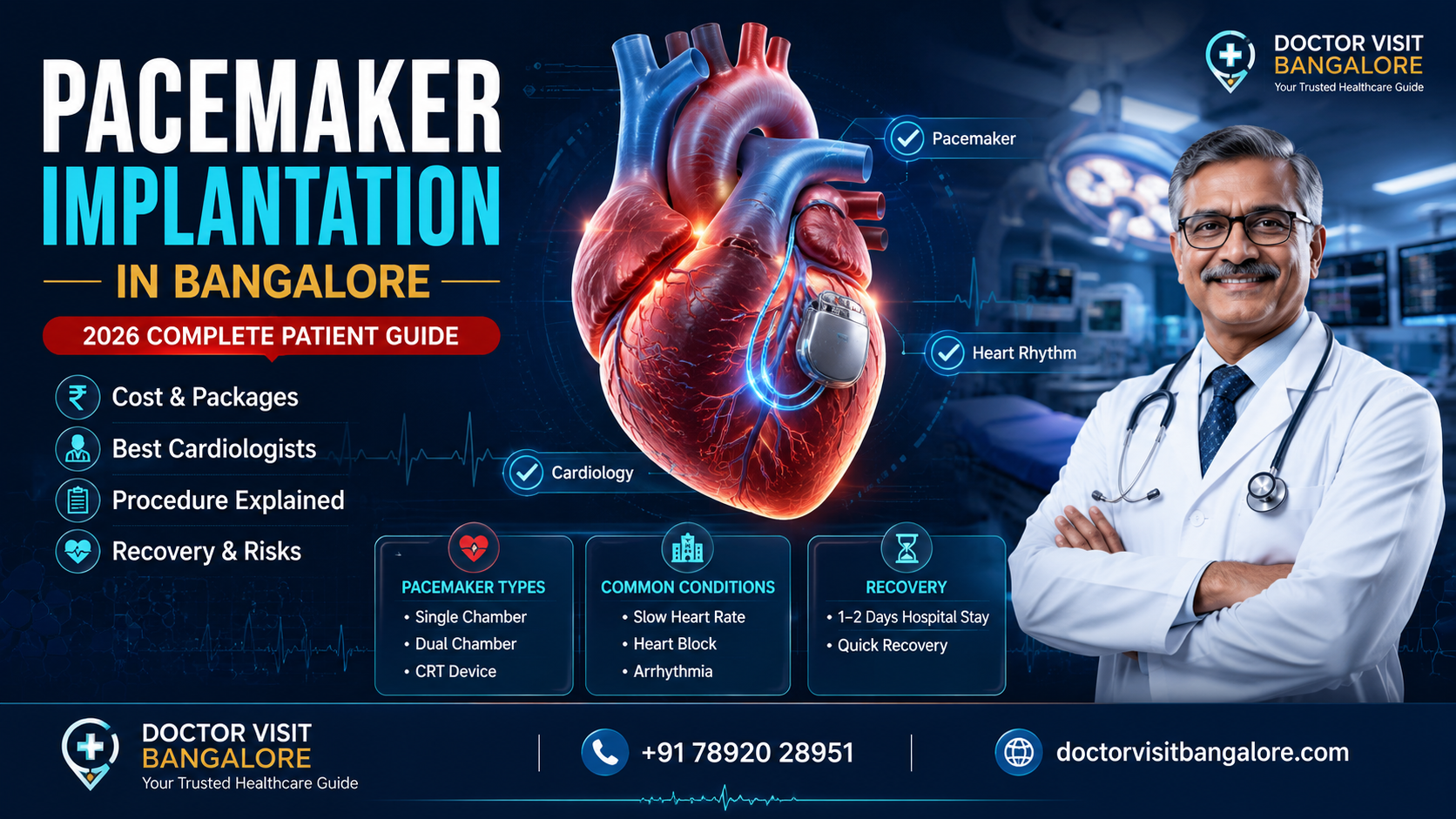
Your heart has been beating without interruption since before you were born — roughly 100,000 times every single day. When that rhythm starts to fail, a pacemaker can restore it. This is the complete 2026 guide to pacemaker implantation in Bangalore — costs, types, procedure, hospitals, doctors, recovery, and everything you need to make an informed decision.
WhatsApp Doctor Visit Bangalore — free guidance, appointment coordination, report forwarding. Call +91 78920 28951 | WhatsApp Now
📋 Table of Contents
- When the Heart Loses Its Rhythm — A Patient Story
- What Is a Pacemaker and How Does It Work?
- Types of Pacemakers — Which One Is Right for You?
- When Do You Need a Pacemaker? — Symptoms & Conditions
- The Pacemaker Implantation Procedure — Step by Step
- Pacemaker Implantation Cost in Bangalore 2026
- Best Hospitals for Pacemaker Implantation in Bangalore
- Best Doctors for Pacemaker Implantation in Bangalore
- Recovery After Pacemaker Surgery — What to Expect
- Living With a Pacemaker — Complete Guide
- International Patients — Nigeria, Kenya, Bangladesh, UAE, Oman
- Frequently Asked Questions
1. When the Heart Loses Its Rhythm
Rajan was 67 years old when he fainted while watering his garden one Tuesday morning in Jayanagar.
His wife found him on the ground, conscious but confused. She thought it was the heat. She brought him water. He sat for a while, said he felt fine, and went inside.
It happened again three weeks later — this time while walking to the corner store. He felt dizzy, grabbed a wall, and slid to the ground. A neighbour helped him home.
At the hospital, the ECG told the story. His heart rate was dropping to 38 beats per minute at rest — nearly half what it should be. His heart’s natural electrical system was failing. The SA node — the small cluster of cells that generates every heartbeat — was no longer keeping a reliable pace.
The cardiologist said four words: “You need a pacemaker.”
Rajan spent three days researching online, terrified. He thought a pacemaker meant open heart surgery. He thought he would never be able to exercise again. He thought it would cost him his entire retirement savings.
None of those things were true.
The procedure took 90 minutes. Local anaesthesia. A small incision near his collarbone. He went home the next day. Six weeks later, he was back in his garden — and his heart was beating at a steady, reliable 70 beats per minute.
Over 95% of patients who receive a pacemaker report feeling significantly better and improved heart function after implantation. Most return to normal daily activities within 4–6 weeks.
2. What Is a Pacemaker and How Does It Work?
A pacemaker is a small electronic device — roughly the size of a matchbox, weighing between 20 and 50 grams — that is implanted under the skin near the collarbone to regulate the heart’s electrical system. It monitors the heart rhythm continuously and delivers a small, painless electrical impulse to the heart when needed.
The human heart has its own natural pacemaker — a group of cells in the right atrium called the sinoatrial (SA) node — which generates the electrical signal that triggers every heartbeat. When this system is damaged or disrupted by ageing, heart disease, medication side effects, or other conditions, the heart can beat too slowly, too fast, or irregularly. An implanted pacemaker steps in to correct this.
🔧 The Two Main Components of a Pacemaker:
⚡ Pulse Generator
The metal case containing the battery and the computer circuitry. Implanted under the skin, usually just below the left or right collarbone. Lasts 10–15 years before the battery needs replacing.
🔌 Leads (Electrodes)
Thin, flexible, insulated wires that travel from the pulse generator through a vein into the heart chambers. They both sense the heart’s electrical activity and deliver the pacing impulse when needed.
Modern pacemakers are intelligent devices. They do not pace continuously — they only fire when the heart’s own rhythm falls below the programmed threshold. They can also adjust the pacing rate based on your activity level, speeding up during exercise and slowing down at rest, thanks to built-in motion sensors.
3. Types of Pacemakers — Which One Is Right for You?
The type of pacemaker recommended for you depends entirely on your specific heart condition — the type of arrhythmia, which chambers are affected, and the overall function of your heart. Here is a clear explanation of each type:
💓 Single Chamber Pacemaker
One lead placed in either the right atrium or right ventricle. Used when only one chamber of the heart needs pacing. Suitable for patients with simple bradycardia (slow heart rate) or a basic conduction block.
Cost: ₹80,000 – ₹1.5 lakh
💓💓 Dual Chamber Pacemaker
Two leads — one in the right atrium, one in the right ventricle. Coordinates the timing between the upper and lower heart chambers, mimicking the heart’s natural sequence more closely. Recommended for most patients with AV (atrioventricular) block.
Cost: ₹1.5 lakh – ₹3 lakh
🔄 Biventricular Pacemaker (CRT)
Three leads — right atrium, right ventricle, and left ventricle. Used for patients with heart failure and bundle branch block where both ventricles need to be resynchronised. Also known as Cardiac Resynchronisation Therapy (CRT).
Cost: ₹3 lakh – ₹6 lakh
⚡ Leadless Pacemaker (Micra)
No leads, no incision near the collarbone. A tiny capsule is inserted directly into the heart through a catheter in the groin vein. About one-tenth the size of a conventional pacemaker. Suitable for selected single-chamber pacing needs. Available in Bangalore at select hospitals.
Cost: ₹4 lakh – ₹9 lakh
⚡ ICD — Implantable Cardioverter Defibrillator
A combination device that both paces the heart and can deliver an electric shock to restore rhythm in life-threatening arrhythmias like ventricular fibrillation. Recommended for patients at high risk of sudden cardiac death.
Cost: ₹5 lakh – ₹12 lakh
🔋 Temporary Pacemaker
Used during emergencies or while preparing for a permanent device. External leads are placed and connected to an external device outside the body. Not implanted — used for days to weeks in hospital settings such as ICU or post-heart attack management.
Used in ICU/emergency settings only
4. When Do You Need a Pacemaker? — Symptoms and Conditions
Not every heart rhythm problem needs a pacemaker. The decision is made by a cardiologist after detailed investigation — including an ECG, Holter monitor (24–72 hour heart recording), echocardiogram, and sometimes a stress test. Here are the conditions that most commonly lead to a pacemaker recommendation:
🐢 Bradycardia
Resting heart rate below 60 bpm (or symptomatic below 50 bpm). Causes fatigue, dizziness, shortness of breath, and fainting. The most common reason for pacemaker implantation.
🔌 Heart Block
The electrical signal between the upper and lower heart chambers is delayed or blocked (1st, 2nd, or 3rd degree AV block). 3rd degree (complete) heart block almost always requires a pacemaker.
😴 Sick Sinus Syndrome
The SA node fails to generate reliable signals — causing the heart to beat too slowly, pause, or alternate between slow and fast. Common in elderly patients.
💓 Heart Failure
CRT (biventricular pacemaker) may be recommended when the left ventricle’s pumping function is severely reduced and both ventricles need resynchronisation to improve cardiac output.
⚡ After Cardiac Surgery
Some patients develop permanent conduction problems after bypass surgery, valve replacement, or other cardiac procedures — making a pacemaker necessary post-operatively.
🚨 Symptoms That Need Urgent Evaluation
- Unexplained fainting (syncope)
- Near-fainting or sudden dizziness
- Extreme unexplained fatigue
- Shortness of breath at rest
- Palpitations with a very slow pulse
5. The Pacemaker Implantation Procedure — Step by Step
Most patients feel a deep sense of anxiety about pacemaker surgery because they imagine something large, painful, and frightening. The reality — for most patients — is very different. Here is exactly what happens:
Pre-Procedure Assessment
Blood tests, ECG, echocardiogram, chest X-ray, and Holter monitoring confirm the diagnosis and determine the correct pacemaker type. Blood thinners may be stopped 2–3 days before. Fasting for 6–8 hours before the procedure.
Anaesthesia — Local, Not General
The area near the collarbone is numbed with local anaesthesia. Mild sedation is given to help you relax. You remain awake but comfortable throughout. This is not open heart surgery — the chest is not opened.
Small Incision Near the Collarbone
A small incision (approximately 5 cm) is made just below the collarbone. The subclavian or cephalic vein is accessed to guide the pacemaker leads into the heart under X-ray guidance (fluoroscopy).
Lead Placement and Testing
One or more leads are guided through the vein into the correct heart chambers. The lead tip is positioned carefully and tested to confirm it delivers the right threshold of electrical stimulation. This is the most technically precise part of the procedure.
Pulse Generator Implanted
A small pocket is created under the skin below the collarbone. The pulse generator is placed in this pocket and connected to the leads. The incision is closed with skin sutures only — no muscle or bone is cut.
Programming and Discharge
Before discharge, the pacemaker is programmed externally using a wireless programmer — adjusting the pacing rate, sensitivity, and other parameters to suit your specific needs. Most patients are discharged within 24–48 hours. A pacemaker identity card is issued.
❤️ Advised pacemaker surgery? We can help you book the right hospital and doctor.
WhatsApp your reports — we’ll coordinate everything. Free service.
6. Pacemaker Implantation Cost in Bangalore 2026
The cost of pacemaker implantation in Bangalore varies significantly depending on the type of device, the hospital, the room category, and the complexity of the case. Here is a complete 2026 cost breakdown:
| Pacemaker Type | Cost Range (₹) | Cost Range (USD) | Best For |
|---|---|---|---|
| Single Chamber Pacemaker | ₹80,000 – ₹1,50,000 | $960 – $1,800 | Simple bradycardia, atrial/ventricular pacing |
| Dual Chamber Pacemaker | ₹1,50,000 – ₹3,00,000 | $1,800 – $3,600 | AV block, sick sinus syndrome |
| Biventricular Pacemaker (CRT) | ₹3,00,000 – ₹6,00,000 | $3,600 – $7,200 | Heart failure, bundle branch block |
| ICD (Defibrillator + Pacemaker) | ₹5,00,000 – ₹12,00,000 | $6,000 – $14,400 | High risk of sudden cardiac death |
| Leadless Pacemaker (Micra) | ₹4,00,000 – ₹9,00,000 | $4,800 – $10,800 | Selected patients, no vein access |
| Pacemaker Battery Replacement | ₹60,000 – ₹1,50,000 | $720 – $1,800 | After 10–15 years (device replacement) |
* 2026 estimates. Actual costs vary by hospital, device brand, room category, pre-existing conditions, and investigations required. Government hospitals like Sri Jayadeva are significantly cheaper. Insurance often covers pacemaker implantation — verify with your insurer.
- Device brand and model — Indian-manufactured pacemakers cost less than imported brands (Medtronic, Abbott, Boston Scientific)
- Hospital type — Government (Sri Jayadeva) is cheapest; private (Apollo, Manipal, Fortis) costs more but offers premium facilities
- Room category — General ward, semi-private, or private room adds ₹1,000–₹5,000 per day
- Pre-procedure investigations — Holter, echo, CT angiography add ₹10,000–₹40,000
- Insurance coverage — Most health insurance policies in India cover pacemaker implantation; Ayushman Bharat (PM-JAY) covers it at government hospitals
7. Best Hospitals for Pacemaker Implantation in Bangalore
❤️ Sri Jayadeva Institute (SJICR)
📍 Bannerghatta Road, Jayanagar, Bangalore
India’s largest dedicated cardiac institution — 600 beds, 26,000+ cathlab procedures annually, 3,000+ open heart surgeries. Government hospital — most affordable pacemaker implantation in Bangalore. Former director Dr. CN Manjunath (Padma Shri) is among India’s most decorated cardiologists.
Cost level: Lowest — government rates
✅ Best for affordable, high-volume cardiac care🏥 Narayana Institute of Cardiac Sciences
📍 Bommasandra, Bangalore (founded by Dr. Devi Shetty)
Founded by Padma Bhushan Dr. Devi Prasad Shetty — one of India’s most celebrated cardiac institutions. Combines world-class care with affordable pricing. Pacemaker cost starts at ₹1,20,000. Advanced cardiac cathlab infrastructure, electrophysiology labs, and device programming.
Cost level: Affordable-moderate
✅ Best for quality + affordability combination🏥 Manipal Hospitals
📍 Old Airport Road, Malleshwaram, Sarjapur, Yeshwantpur, Hebbal
Ranked #1 private hospital in Bangalore for 16 consecutive years. Multiple campuses across the city — excellent for international patients. Pacemaker cost ₹1,20,000–₹2,00,000. Experienced electrophysiologists, advanced cardiac device labs, and JCI/NABH accredited.
Cost level: Moderate-premium
✅ Best for international patients, multiple locations🏥 Apollo Hospitals
📍 Bannerghatta Road, Jayanagar, Seshadripuram
Apollo’s cardiac team has performed 300,000+ heart procedures with 95%+ success rates. Pacemaker cost ₹1,20,000–₹2,00,000. Full electrophysiology and cardiac device programme. Leadless Micra pacemaker available. Strong international patient support team.
Cost level: Moderate-premium
✅ Best for complex cases and international patients🏥 Fortis Hospitals
📍 Bannerghatta Road, Cunningham Road, Millers Road
Home to Dr. Vivek Jawali, Chairman of Cardiovascular Sciences. Full range of cardiac device implantation — pacemakers, ICDs, CRT devices. Advanced cathlab with electrophysiology suites. Strong post-procedure follow-up programme.
Cost level: Moderate-premium
✅ Best for complex arrhythmia + device cases🏥 Aster CMI Hospital
📍 Hebbal, North Bangalore
Excellent North Bangalore option for pacemaker implantation. NABH accredited. Large volume of cardiac procedures annually. Electrophysiologists and interventional cardiologists available. Strong ICU support for complex post-procedure management.
Cost level: Moderate
✅ Best for North Bangalore patients8. Best Doctors for Pacemaker Implantation in Bangalore
Pacemaker implantation is performed by interventional cardiologists or electrophysiologists — not general physicians. An electrophysiologist (EP specialist) is a cardiologist with additional training specifically in heart rhythm disorders and cardiac device implantation. Here are Bangalore’s leading names:
Dr. CN Manjunath
Padma Shri | Sri Jayadeva Institute / Bangalore Hospitals
30+ years, 26,000+ interventions, inventor of Manjunath Technique for balloon valvuloplasty. One of India’s most decorated interventional cardiologists. Consultation: ₹800.
→ Read full profileDr. Vivek Jawali
Chairman, Cardiovascular Sciences | Fortis Hospitals Bangalore
39–48 years experience, 18,000+ cardiac surgeries. India’s first beating-heart bypass, MIDCAB, and awake heart surgery. BC Roy Award recipient.
→ Read full profileDr. G Chandrashekar
CTVS Surgeon | Trustwell Hospitals, East Point, Altius Hospital
36+ years, 5,000+ surgeries, international fellowship in Belgium and UK. Former Head of Cardiac Surgery, SSSIHMS Whitefield. Three active Bangalore hospital locations.
→ Read full profileDr. Girish B Navasundi
Senior Consultant Cardiologist | Apollo Hospitals, Bannerghatta
21 years of experience. Interventional cardiologist at Apollo Hospitals, Bannerghatta Road — one of Bangalore’s busiest pacemaker implantation teams.
Dr. Vithal D Bagi
Consultant Cardiologist | Apollo Hospitals, Bannerghatta & Jayanagar
Specialist in permanent pacemaker implantation. Uses minimally invasive approach — small incision, local anaesthesia, no muscle or bone cutting. Publications in Indian Heart Journal and British Medical Journal.
9. Recovery After Pacemaker Surgery — What to Expect
Recovery after pacemaker implantation is faster than most people expect. Here is a clear, week-by-week guide:
🏥 Day 1–2 (Hospital)
- Monitored in cardiac ward
- ECG confirms pacemaker function
- Chest X-ray verifies lead position
- Mild soreness at incision site
- Discharged with pacemaker card
🏠 Week 1–2 (Home)
- Rest at home
- Avoid raising arm above shoulder
- No driving for 1 week
- Wound care as instructed
- Light walking permitted
🚶 Week 3–6 (Return to normal)
- First follow-up appointment
- Pacemaker checked and reprogrammed if needed
- Return to most daily activities
- Can resume driving
- Light exercise cleared
📅 Long-Term Follow-Up
- Device check every 3–6 months
- Remote monitoring available at some centres
- Battery life 10–15 years
- Generator replaced when battery low
- Leads usually kept for life
10. Living With a Pacemaker — Complete Guide
Most patients lead completely normal lives with a pacemaker. Here is a practical guide to daily life after implantation:
✅ You Can Do
- Normal daily activities
- Walking, swimming, light exercise
- Travel including air travel
- Use mobile phones (keep 6 inches away)
- Use microwave ovens
- Work (most occupations)
⚠️ Avoid or Take Precautions
- MRI scans (notify beforehand — some pacemakers are MRI-compatible)
- Standing near industrial welding equipment
- Contact sports with chest impact
- Some high-power electrical equipment
- Airport security — always show pacemaker card
📋 Always Do
- Carry your pacemaker identity card at all times
- Inform all doctors and dentists you have a pacemaker
- Attend all follow-up appointments
- Know the symptoms that need immediate attention
- Keep your device centre’s number saved
❤️ Advised pacemaker surgery — for yourself or a family member?
WhatsApp your ECG or Holter report to Doctor Visit Bangalore — we’ll match you to the right specialist, the right hospital, and give you a cost estimate. Free of charge.
11. International Patients — Nigeria, Kenya, Bangladesh, UAE, Oman
Pacemaker implantation in Bangalore costs 60–80% less than in the USA, UK, or Singapore — with outcomes at experienced centres that are entirely comparable. For international patients from Nigeria, Kenya, Bangladesh, the UAE, and Oman, Bangalore offers additional advantages:
- Direct flights: Daily flights from Dubai, Doha, Nairobi, and Dhaka to Kempegowda International Airport, Bangalore
- Medical visa: India’s MED visa covers cardiac procedures. Doctor Visit Bangalore provides the invitation letter
- Short stay: Pacemaker implantation requires only 3–5 days in Bangalore in most cases — making it practical for medical travel
- Language: Full English support. Bengali-language assistance available through Doctor Visit Bangalore’s founder
- Free coordination: Doctor Visit Bangalore handles appointments, report forwarding, cost estimates, visa letters, and ground support — at no charge
🔗 Related Pages on Doctor Visit Bangalore
12. Frequently Asked Questions
Is pacemaker implantation a dangerous surgery?
Pacemaker implantation is generally considered a low-risk procedure. It is performed under local anaesthesia, does not involve opening the chest, and most patients are discharged within 24–48 hours. The overall success rate is above 90% and over 95% of patients report improved heart function and quality of life post-procedure. Risks do exist — including infection, lead displacement, and bleeding — but serious complications are uncommon at experienced centres.
What is the cheapest hospital for pacemaker implantation in Bangalore?
Sri Jayadeva Institute of Cardiovascular Sciences and Research (SJICR) on Bannerghatta Road is a government hospital and offers the lowest cost pacemaker implantation in Bangalore — with highly experienced cardiologists. Narayana Institute of Cardiac Sciences (Narayana Health) at Bommasandra is the most affordable private hospital option. Doctor Visit Bangalore can help you compare costs across hospitals based on your specific device type.
Does health insurance cover pacemaker implantation in India?
Yes — most health insurance policies in India cover pacemaker implantation as it is classified as a medically necessary cardiac procedure. Ayushman Bharat (PM-JAY) covers it at government and empanelled hospitals. Corporate health insurance and individual health insurance from major providers (Star Health, HDFC Ergo, ICICI Lombard, etc.) typically cover the procedure and the device cost. Always pre-authorise with your insurer before admission.
How long does a pacemaker last before the battery needs replacement?
A pacemaker battery typically lasts between 10 and 15 years, depending on how frequently the device is pacing (if your heart rarely needs the device, the battery lasts longer) and the type of pacemaker. When the battery depletes, the pulse generator is replaced — a simpler procedure than the original implant, as the leads are usually kept in place. The battery level is checked at every follow-up appointment.
Can I travel by air with a pacemaker?
Yes. You can travel by air with a pacemaker. Always carry your pacemaker identity card and show it to airport security — you may need a manual security check instead of walking through certain metal detectors. The pacemaker device itself is not affected by air travel, altitude, or cabin pressure. Most cardiologists advise waiting 4–6 weeks after implantation before long-haul travel.
What is the difference between a pacemaker and an ICD?
A pacemaker monitors and corrects a slow heart rhythm — it delivers small electrical impulses to keep the heart beating at a normal rate. An ICD (Implantable Cardioverter Defibrillator) also paces the heart, but additionally can detect dangerously fast, life-threatening rhythms (ventricular fibrillation) and deliver a shock to restore normal rhythm. An ICD is recommended for patients at high risk of sudden cardiac death — it is not the same as a standard pacemaker.
Can I exercise after pacemaker implantation?
Yes. Most patients can return to light exercise — walking, swimming — within 4–6 weeks. Rate-responsive pacemakers automatically increase the pacing rate when you exercise, allowing your heart to meet the demands of physical activity. Your cardiologist will advise on the specific level of exercise appropriate for your condition and the type of pacemaker you have.
How do I book a pacemaker consultation in Bangalore through Doctor Visit Bangalore?
WhatsApp Doctor Visit Bangalore at +91 78920 28951. Share your ECG, Holter report, or any other cardiac investigations you have. We will match you to the right cardiologist at the right hospital for your specific condition and budget, book your appointment, and prepare you for what to expect. Our service is completely free of charge to patients.
Final Word
Rajan is back in his garden. His heart beats at a steady 70 times per minute. The dizziness is gone. The fainting is gone. He plays with his grandchildren on Sunday mornings without fear.
A device the size of a matchbox — placed under his skin in 90 minutes under local anaesthesia — gave him his life back.
If you or someone you love has been told they need a pacemaker — or if you have been experiencing fainting, extreme fatigue, or very slow pulse — please do not wait. Bangalore has some of India’s finest cardiac centres and most experienced cardiologists. Pacemaker implantation here is affordable, well-established, and in the right hands, genuinely life-changing.
Doctor Visit Bangalore is here to guide you through every step — from the first WhatsApp message to the day you go home with your pacemaker card. Free of charge. Always.
Your heart has been beating since before you were born. It deserves the best care available.
Tags:
Sources: HexaHealth — Pacemaker Implantation Cost Bangalore 2026; MediGence — Best Pacemaker Hospitals Bangalore; Dr. Vithal D Bagi Heart Centre — Pacemaker Cost Bangalore; indiacardiacsurgerysite.com — Pacemaker Surgery Cost India 2026; Sehat — Dr. CN Manjunath profile; Wikipedia — C N Manjunath; Sri Jayadeva Institute official CV (jayadevacardiology.com); Practo — Pacemaker Surgery Bangalore; my1health.com — Best Hospitals India Pacemaker Surgery; MediGence — Apollo Hospitals Bannerghatta Pacemaker.
This page follows the Doctor Visit Bangalore Editorial Policy. All cost figures are approximate estimates for 2026 — actual costs vary. This article is for informational purposes only and does not replace consultation with a qualified cardiologist.
Arman Ali is the founder of Doctor Visit Bangalore, a trusted healthcare navigation platform helping patients find verified doctors, hospitals, and specialists across Bangalore and all over in India. With hands-on experience in healthcare research and patient assistance, Arman has personally helped hundreds of domestic and international patients connect with leading hospitals including Apollo, Manipal, Fortis, and Aster. His content is grounded in real hospital data, treatment cost research, and direct coordination with medical professionals across Bangalore. He specializes in medical tourism guidance, treatment cost transparency, and specialist discovery for complex conditions including cancer, cardiac surgery, and orthopedic care.