
PLID Explained: What an L4-L5 Slipped Disc Really Means — and How Amara Found Her Way Back to Walking Pain-Free
Everything you need to know about PLID in plain language — symptoms, exercises, treatment, and surgery cost in India — explained the way we explained it to her.
“I’m a schoolteacher in Nairobi. For the last four months I’ve had pain shooting from my lower back into my right leg — some days I can barely stand at the front of my classroom. My doctor said it’s L4-L5 PLID. I don’t even know what that means. Is this something I’ll need surgery for?”
Amara had been a teacher for over twenty years. She was used to standing for hours, writing on the board, walking between rows of desks. So when a dull ache in her lower back turned into a sharp, burning pain running down her right leg, she assumed it was just tiredness — until it got so bad she had to sit through her own lessons.
Her local doctor ordered an MRI. The report came back with a term she’d never heard before: PLID at L4-L5. No further explanation, just a referral to a spine specialist and a growing pile of questions.
This is one of the most common messages we receive — someone handed a diagnosis full of medical shorthand, and left to Google the rest alone at 2am. So this article answers every question Amara asked us, in plain language, exactly the way we explained it to her — what PLID actually is, whether it’s serious, how it’s treated, what it costs to treat in India, and what a real recovery looks like.
Get Your FREE Evaluation
What Is PLID? (In Plain Language)
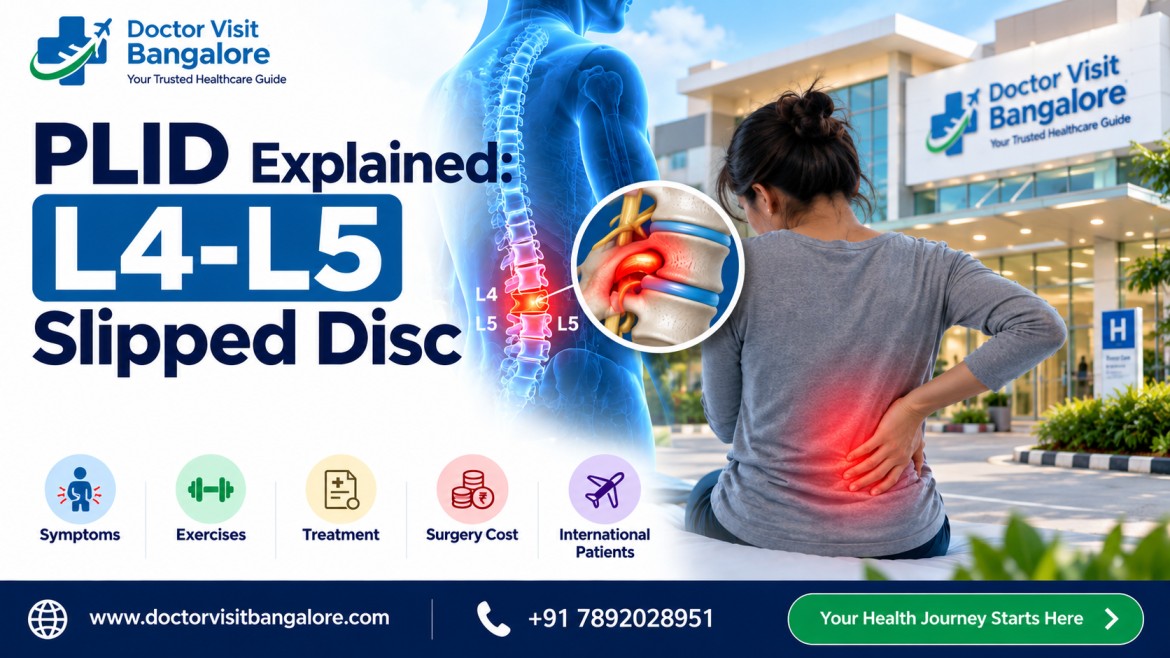
PLID stands for Prolapsed Lumbar Intervertebral Disc — most people simply call it a slipped disc or herniated disc. It’s not a disease in the infectious sense; it’s a mechanical problem in the spine.
Think of the discs in your lower back as small, round cushions sitting between each bone (vertebra) of your spine. Each disc has a tough outer ring and a soft, gel-like center. When that outer ring develops a tear or weak spot, the soft center can push outward — sometimes pressing on a nearby nerve. That’s the “prolapse,” and it’s what causes the pain, tingling, or weakness people feel down their leg.
The “lumbar” in PLID simply refers to the lower part of your spine — the five vertebrae labelled L1 through L5, which carry most of your body’s weight and handle most of your daily bending and twisting. This is exactly why the lower back is the most common place in the entire spine for this problem to occur.
Slipped Disc vs. Herniated Disc vs. PLID — Are They the Same Thing?
Yes — these are three different names for the exact same condition. This is one of the most common points of confusion for patients researching online, so it’s worth clearing up plainly:
- Slipped disc — the everyday, informal name most people use
- Herniated disc — the term most commonly used in Western medical literature
- PLID (Prolapsed Lumbar Intervertebral Disc) — the more formal medical term, especially common on reports and prescriptions in India and South Asia
If your report says PLID and a friend’s says “herniated disc,” you’re both talking about the same underlying problem. There’s no meaningful medical difference between the three — just different naming conventions.
What Does “L4-L5 PLID” Mean?
Amara’s report specifically said L4-L5. This simply tells you exactly which disc is affected — the one sitting between the fourth and fifth lumbar vertebrae, right near the base of your spine.
L4-L5 (along with the L5-S1 disc just below it) is, by a wide margin, the most commonly affected level in the entire spine. This is simply because it carries the greatest load and experiences the most movement of any disc in your back — every time you bend forward, twist, or lift something, this level absorbs a large share of the stress.
A disc problem at L4-L5 frequently affects the sciatic nerve, which is exactly why pain from this level often doesn’t stay in the back — it travels down the buttock, the back of the thigh, and sometimes all the way to the foot. This radiating leg pain is commonly called sciatica.
What Are the Signs of Disc Issues?
PLID doesn’t always look the same in every person, but the most common signs include:
- Lower back pain that may come and go, or stay constant
- Pain radiating into the buttock, thigh, or down one leg (sciatica)
- Tingling or a “pins and needles” sensation in the leg or foot
- Numbness along the path of the affected nerve
- Muscle weakness, or a feeling that your leg might give way
- Pain that worsens with sitting, bending, coughing, or sneezing, and often eases with lying down
In rare and more serious cases, a large disc prolapse can press on multiple nerves at once and affect bladder or bowel control, or cause sudden, significant leg weakness. This is considered a medical emergency and needs immediate attention — it is not the typical presentation of PLID, but it’s important to know the warning sign.
Does PLID Always Cause Sciatica?
Not always, but very often — especially at the L4-L5 or L5-S1 levels. The sciatic nerve is formed by nerve roots exiting the lower spine, so when a disc at this level presses on one of those roots, the pain travels along the sciatic nerve’s path: through the buttock, down the back of the thigh, and sometimes into the calf or foot. This is exactly why PLID and sciatica are so closely linked in people’s search results — one is often the direct cause of the other.
Can PLID Cause Paralysis?
This is a real and understandable fear, but it’s important to have the accurate picture: true paralysis from PLID is very rare. It can only happen in a severe, specific scenario — usually a very large central disc prolapse compressing the entire bundle of nerves at the base of the spine (a condition called cauda equina syndrome), which also typically causes loss of bladder or bowel control alongside leg weakness. This is a genuine medical emergency requiring urgent surgery, but it represents a small minority of PLID cases. For the vast majority of patients, PLID causes pain and discomfort, not permanent paralysis.
Are Disc Problems Serious? Is PLID a Serious Disease?
This is usually the first real fear behind every PLID question, so let’s answer it honestly: most cases of PLID are not dangerous, and the large majority improve significantly with time and the right conservative treatment. It is a genuinely common condition — a meaningful percentage of adults will experience a disc herniation at some point, and it is rarely life-threatening.
That said, “not usually dangerous” doesn’t mean “ignore it.” Persistent pain, worsening weakness, or any loss of bladder/bowel control are signals that this needs proper medical evaluation — not self-treatment. The honest, reassuring truth for most patients like Amara is this: PLID is uncomfortable and disruptive, but it is very treatable, and the vast majority of people recover well.
How Is PLID Diagnosed?
Diagnosis usually happens in a few straightforward steps:
- Clinical examination — the doctor checks your reflexes, muscle strength, and how far you can move without pain, along with specific tests like the “straight leg raise” that help pinpoint nerve involvement
- MRI scan — the gold-standard imaging test, since it clearly shows the soft disc tissue and exactly where and how much it’s pressing on a nerve
- X-ray — sometimes used first to rule out other bone-related causes of back pain, though it doesn’t show the disc itself as clearly as an MRI
- Nerve conduction studies — occasionally used in more complex cases to measure how well electrical signals are traveling along the affected nerve
If you already have a recent MRI report, as many international patients do, sharing it in advance can significantly speed up your specialist consultation and treatment planning.
What Is the Treatment for PLID?
Treatment almost always starts conservative — meaning non-surgical — and only escalates if that doesn’t provide enough relief.
Non-Surgical (Conservative) Treatment
- Pain-relief and anti-inflammatory medication
- Physiotherapy and guided exercise (much more effective long-term than rest alone)
- Epidural steroid injections, in select cases, to reduce nerve inflammation
- Short-term activity modification — not complete bed rest (more on this below)
PLID Home Remedies
Alongside medical treatment, several simple home measures can genuinely help manage symptoms while your disc heals:
- Alternating heat and cold packs on the lower back to ease muscle spasm and inflammation
- Gentle movement and short walks instead of prolonged lying down
- Maintaining good posture while sitting, with lumbar support if needed
- Sleeping on your side with a pillow between your knees to reduce spinal strain
Home remedies can meaningfully ease discomfort, but they work best alongside — not instead of — a proper medical evaluation, especially if pain is severe or persistent.
Physiotherapy for PLID
Physiotherapy is genuinely one of the most effective tools for PLID recovery. A physiotherapist builds a personalized plan — usually starting with gentle pain-relief techniques and progressing to core-strengthening and posture-correction exercises as pain settles. This structured, gradual approach is a major reason most patients recover without ever needing surgery.
How Long Does a Slipped Disc Take to Heal Naturally?
This varies quite a bit from person to person. Many patients notice meaningful improvement within 4 to 6 weeks of consistent conservative treatment, while some take a few months for symptoms to fully settle. Recovery speed depends on the size of the disc prolapse, which nerve is affected, and how consistently the treatment plan (physiotherapy, activity modification, medication) is followed.
Can L4-L5 (or PLID) Be Cured Without Surgery?
Yes — for most patients, PLID improves without surgery. The general medical guidance is that surgery is only considered once around six weeks of proper conservative treatment hasn’t provided meaningful relief, or if there are more urgent warning signs like significant weakness or loss of bladder/bowel control. Many patients recover well with physiotherapy, targeted exercise, and time alone.
Can PLID Be Cured?
“Cured” is a strong word for any condition involving natural wear on the spine, but the practical answer patients want to hear is this: symptoms can be effectively resolved for the vast majority of people, either through conservative care or — when genuinely needed — through surgery, after which most patients return to a full, active, pain-free life.
Is Bed Rest Good for a Slipped Disc?
No — modern medical guidance actually advises against prolonged bed rest. This is a common misconception. Doctors used to recommend strict bed rest for back pain, but that approach has changed. Extended lying down or inactivity can actually make a slipped disc worse, weakening the muscles that support your spine and slowing recovery. Today’s guidance favors gentle movement and gradual, guided activity over complete rest.
What Exercises Are Recommended for PLID? Is Walking Good for L4-L5 Pain?
Yes — walking is one of the simplest and most recommended activities for L4-L5 disc pain. It’s low-impact, keeps blood flowing to the healing area, and doesn’t put the same compressive strain on the spine that sitting for long periods does. Short, frequent walks are generally far better for recovery than staying still.
Generally Recommended Exercises
- Walking — short, frequent sessions rather than one long walk
- Pelvic tilts — a gentle core-activation movement done lying down
- Core-stabilization exercises, guided by a physiotherapist
- Gentle stretching of the hips and hamstrings (only once acute pain has settled)
- Supervised, low-impact yoga, with a doctor’s clearance
Exercises to Avoid
- Heavy leg press or loaded squats
- Sit-ups and crunches (they add pressure directly onto the lumbar discs)
- Toe-touches or standing forward bends with straight legs
- High-impact activity like running or jumping during acute pain
- Any exercise causing sharp pain, numbness, or tingling — stop immediately
Always start slowly, and always get clearance from your doctor or physiotherapist before beginning any new exercise — every patient’s disc, pain level, and nerve involvement is different.
How to Keep Your Spine Discs Healthy Long-Term
- Maintain a healthy body weight to reduce load on the lower spine
- Practice good lifting technique — bend your knees, not your back
- Avoid prolonged sitting; take standing or walking breaks regularly
- Build core and back muscle strength through regular, appropriate exercise
- Avoid smoking, which is linked to faster disc degeneration
- Use proper posture and ergonomic support when sitting for long hours
What Is PLID Surgery?
When conservative treatment genuinely isn’t enough, surgery aims to relieve pressure on the compressed nerve. The good news is that most PLID surgery today is minimally invasive.
Microdiscectomy
The most common and well-established surgery for PLID. A small portion of the herniated disc material is removed through a small incision, taking pressure off the nerve. It has a long track record and a high success rate.
Endoscopic Discectomy
A newer, even less invasive technique using a small camera and instruments through a tiny opening. It’s associated with less bleeding, a smaller wound, and often a quicker return to daily activity — though it requires specific surgeon training.
In some cases, a laminectomy (removing a small piece of bone to relieve pressure on the nerves) may be recommended alongside discectomy, particularly if there’s also narrowing of the spinal canal. For a small number of more complex or recurring cases, spinal fusion may be advised to stabilize the spine — though this is not the typical treatment path for a straightforward PLID case.
Laminectomy vs. Discectomy — What’s the Difference?
A discectomy removes the herniated portion of the disc itself. A laminectomy removes a small piece of bone (the lamina) covering the spinal canal to create more room for the nerves. They’re not competing alternatives — they’re often done together when a patient has both a disc prolapse and some narrowing of the spinal canal, while a straightforward disc herniation alone may only need a discectomy.
When Is Surgery Actually Needed for PLID?
The general clinical guideline is straightforward: surgery is typically considered once around six weeks of proper conservative treatment hasn’t provided meaningful relief, or immediately if there are urgent warning signs like significant progressive weakness or loss of bladder/bowel control. Outside of those situations, most surgeons will recommend giving conservative treatment a genuine chance first.
Is PLID Surgery a Major Surgery? What’s the Success Rate?
Modern PLID surgery — particularly microdiscectomy and endoscopic discectomy — is considered minimally invasive rather than “major” surgery in the traditional sense. It’s done through small incisions, often takes under two hours, and typically allows patients to walk the same or next day. Success rates for well-selected patients are generally high, with the large majority experiencing significant, lasting relief from leg pain in particular.
What Are the Risks of PLID Surgery? Can It Come Back?
As with any surgery, there are risks — including infection, bleeding, or, in rare cases, nerve irritation — though serious complications are uncommon with an experienced spine surgical team. It’s also fair to know that disc herniation can recur, either at the same level or a different one, in a minority of patients, which is why post-surgery exercise, posture, and lifestyle habits (the same ones covered earlier in this article) genuinely matter long after you’ve recovered.
What Happens If PLID Is Left Untreated?
Many mild cases improve on their own even without formal treatment. But leaving significant symptoms unaddressed for a long period can allow nerve compression to persist or worsen, potentially leading to prolonged pain, ongoing numbness, or muscle weakness that becomes harder to fully reverse. This is why a proper diagnosis — even if the eventual answer is “you don’t need surgery” — is worth getting rather than guessing.
PLID Surgery Cost in India
For international patients, cost is naturally one of the biggest deciding factors — and it’s exactly why so many patients from Africa, the Middle East, Southeast Asia, and the West are choosing India for spine treatment.
| Procedure / Item | Typical Range (USD) |
|---|---|
| Microdiscectomy | 4,000 – 6,500 |
| Endoscopic Discectomy | 4,500 – 7,500 |
| Laminectomy | 4,000 – 6,000 |
| Spinal Fusion (if required) | 7,000 – 12,000 |
| Pre-operative tests & consultation | 300 – 800 |
| Accommodation near hospital (per night) | 18 – 50 |
For context, spine surgery in India is typically 50–70% cheaper than the same procedure in the US, UK, or Western Europe, while still being performed at accredited hospitals by internationally trained spine surgeons. Actual cost depends on your specific diagnosis, the exact surgical technique needed, hospital choice, and room category — which is exactly why a personalized quote (not a generic number) matters.
🔗 If a microdiscectomy is what’s actually been recommended for you, our complete Lumbar Microdiscectomy guide walks through the real procedure step-by-step, with an actual patient’s MRI findings and recovery timeline.
How Does India Compare to Other Medical Tourism Destinations?
| Country | Typical Range (USD) |
|---|---|
| India | 4,000 – 9,500 |
| Turkey | 4,500 – 10,000 |
| South Korea | 7,000 – 11,000 |
| Mexico | 7,000 – 20,000 |
India consistently sits at the more affordable end among established medical tourism destinations for spine care, without compromising on surgical standards — a genuine reason it has become a top choice for cost-conscious international patients.
Want your real cost estimate for PLID treatment?
Share your MRI report and medical history, and we’ll help you get a transparent, itemized quote before you book any travel.
Get My Cost EstimateBest Hospitals and Doctors for PLID Treatment in Bangalore
This is the single most important decision in the entire journey, and it’s exactly where patients researching from abroad most need real guidance rather than guesswork.
Bangalore has several well-established, accredited multi-specialty hospital groups with dedicated spine and neurosurgery departments — names like Manipal Hospitals, Fortis Hospitals, Apollo Hospitals, and Sakra World Hospital are among the city’s recognized names in advanced spine care. But rather than simply picking a hospital name off a search result, what actually matters for your specific case is matching the right surgeon and facility to your MRI findings, your budget, and your overall health.
What to look for before you commit
- A spine surgeon or neurosurgeon with specific training in minimally invasive/endoscopic spine techniques, not just general orthopedic experience
- A meaningful surgical case volume — ask how many discectomy or spine procedures the surgeon has personally performed
- A hospital with a dedicated spine care unit and modern imaging (MRI/CT) on-site
- Transparent, itemized cost estimates before you travel — no surprise charges later
- International patient support — medical visa guidance, airport pickup, accommodation, and communication assistance
This is exactly the gap Doctor Visit Bangalore exists to close — we review your MRI and medical history first, then match you with a genuinely qualified spine specialist and hospital for your specific case, not a generic recommendation.
Bangalore vs. Chennai vs. Delhi for PLID Treatment
All three cities have genuinely well-regarded spine care hospitals, and the “best” city usually comes down to which specific surgeon and facility fit your case — not the city itself. Bangalore’s advantage for many international patients is its strong concentration of accredited multi-specialty hospitals, English-speaking medical staff, and established international patient support infrastructure, all within a single, easy-to-navigate city.
Do I Need a Medical Visa for Spine Surgery in India?
Most international patients travelling to India specifically for treatment apply for a medical visa (or e-medical visa, depending on nationality). Requirements vary by country, and this is exactly the kind of paperwork we help coordinate — so it’s one less thing to figure out alone while you’re already managing a health concern.
Let us match you with the right spine specialist
Send us your MRI report and we’ll help you find a qualified spine surgeon in Bangalore — plus coordinate travel, stay, and appointments from start to finish.
Find My Specialist Chat on WhatsAppRecovery: How Many Days Should You Plan to Stay in India?
For international patients traveling specifically for PLID surgery, we generally recommend planning for around 10 to 14 days in India.
Most patients are up and walking within a day of surgery, which is part of the recovery process itself. Full recovery and return to normal activity generally continues over several weeks after you’re home, guided by a physiotherapy plan your surgical team provides before you leave.
How Many Days of Rest Are Needed After PLID Surgery?
Most patients need around 2 to 4 weeks of reduced activity after surgery before easing back into normal daily routines, with full recovery and return to more strenuous activity typically taking 6 to 12 weeks, depending on the procedure and how well recovery guidelines are followed.
Can I Fly After Spine Surgery?
Generally, yes — but not immediately. Most surgeons recommend waiting until after your follow-up review (typically a week or so after surgery) before a long-haul flight, to make sure healing is progressing well and to minimize risks from prolonged sitting. Your surgical team will confirm the exact timing based on your specific procedure and recovery.
Patient’s Review
Frequently Asked Questions
What is PLID in medicine?
PLID stands for Prolapsed Lumbar Intervertebral Disc — the medical term for what’s commonly called a slipped or herniated disc in the lower back, where the soft center of a spinal disc pushes out through a tear in its tougher outer layer.
What is PLID disease?
PLID isn’t an infectious “disease” in the traditional sense — it’s a mechanical spine condition caused by wear, injury, or age-related changes to a disc. It’s sometimes loosely referred to as a “disease” in everyday conversation, but medically it’s classified as a degenerative or mechanical spinal condition.
What is PLID (also written “PL ID”)?
PLID is simply the abbreviation for Prolapsed Lumbar Intervertebral Disc. You may sometimes see it typed inconsistently as “PL ID” — it refers to the exact same condition, commonly known as a slipped or herniated disc.
What does “L4-L5 PLID” mean?
It means the disc prolapse is specifically located between the 4th and 5th lumbar vertebrae — the lowest, most heavily loaded part of the spine, and the single most common location for this condition to occur.
What is PLID surgery?
PLID surgery refers to procedures that relieve pressure on a compressed spinal nerve, most commonly a microdiscectomy or endoscopic discectomy, where a small portion of the herniated disc material is removed. It’s typically only recommended after conservative treatment hasn’t provided enough relief.
How is PLID diagnosed?
Through a clinical examination (checking reflexes, strength, and specific nerve-tension tests) combined with an MRI scan, which clearly shows the disc and exactly how much it’s pressing on a nearby nerve.
What is the treatment for PLID?
Treatment usually starts with medication, physiotherapy, and guided exercise. Surgery is considered only if symptoms don’t improve after about six weeks of proper conservative treatment, or if there are more urgent warning signs like significant weakness.
Can PLID be cured?
For most people, yes — symptoms resolve well with conservative treatment or, when genuinely needed, with surgery. Most patients return to a full, active, pain-free life afterward.
Can L4 and L5 be cured without surgery?
In the majority of cases, yes. Most L4-L5 disc problems improve significantly with physiotherapy, guided exercise, medication, and time, without ever needing surgery.
Is bed rest good for slipped discs?
No — prolonged bed rest is generally discouraged today. Gentle movement and gradual activity, guided by a physiotherapist, tends to support recovery far better than staying still.
Is walking good for L4-L5 pain?
Yes, walking is one of the most commonly recommended activities for L4-L5 disc pain. Short, frequent walks are low-impact and support recovery better than prolonged sitting or complete inactivity.
What exercises are recommended for PLID?
Walking, pelvic tilts, guided core-stabilization exercises, and gentle stretching (once acute pain has settled) are commonly recommended. High-impact movements, sit-ups, and heavy loaded lifts are generally best avoided during recovery.
What are signs of disc issues?
Common signs include lower back pain, pain radiating into the buttock or leg (sciatica), tingling, numbness, and muscle weakness. Sudden severe weakness or loss of bladder/bowel control needs immediate medical attention.
Are disc problems serious?
Most disc problems, including PLID, are not dangerous and improve well with proper treatment. However, persistent symptoms or specific warning signs like significant weakness should always be medically evaluated rather than ignored.
How to keep spine discs healthy?
Maintain a healthy weight, use proper lifting technique, avoid prolonged sitting, build core and back strength, avoid smoking, and use good posture — all of these reduce long-term strain on your spinal discs.
How much does PLID surgery cost in India for international patients?
Costs typically range from around USD 4,000 to 7,500 for common procedures like microdiscectomy or endoscopic discectomy, with more complex cases like spinal fusion costing more. Share your MRI with us for a personalized, transparent quote.
Is spine surgery cheaper in India than the USA or UK?
Yes, typically around 50–70% cheaper, while still being performed at accredited hospitals by internationally trained spine surgeons — a major reason India has become a leading medical tourism destination for spine care.
What’s the difference between a slipped disc, herniated disc, and PLID?
Nothing medically — they’re three names for the same condition. “Slipped disc” is the everyday term, “herniated disc” is common in Western medical literature, and “PLID” is the more formal term often used on medical reports in India and South Asia.
Can PLID cause paralysis?
True paralysis from PLID is very rare and only occurs in a severe scenario where a large disc prolapse compresses the entire nerve bundle at the base of the spine, usually alongside loss of bladder or bowel control. For the vast majority of patients, PLID causes pain and discomfort, not permanent paralysis.
How long does a slipped disc take to heal naturally?
Many patients notice meaningful improvement within 4 to 6 weeks of consistent conservative treatment, though some take a few months to fully settle, depending on the size of the prolapse and how consistently the treatment plan is followed.
Is PLID surgery major surgery? What is the success rate?
Modern PLID surgery like microdiscectomy or endoscopic discectomy is minimally invasive rather than major surgery — done through small incisions, often under two hours, with most patients walking the same or next day. Success rates for well-selected patients are generally high, especially for relieving leg pain.
What are the risks of PLID surgery, and can it come back?
As with any surgery, there are risks like infection, bleeding, or rare nerve irritation, though serious complications are uncommon with an experienced team. Disc herniation can recur in a minority of patients, which is why post-surgery exercise and posture habits genuinely matter long-term.
What happens if PLID is left untreated?
Many mild cases improve on their own, but leaving significant symptoms unaddressed can allow nerve compression to persist or worsen, potentially leading to prolonged pain or muscle weakness that becomes harder to fully reverse. A proper diagnosis is always worth getting.
How many days of rest are needed after PLID surgery?
Most patients need around 2 to 4 weeks of reduced activity, with full recovery and return to more strenuous activity typically taking 6 to 12 weeks depending on the procedure.
Can I fly after spine surgery?
Generally yes, but most surgeons recommend waiting until after your follow-up review (typically about a week after surgery) before a long-haul flight, to confirm healing is progressing well.
Do I need a medical visa for spine surgery in India?
Most international patients apply for a medical visa or e-medical visa, depending on their nationality. Requirements vary by country, and this is something Doctor Visit Bangalore helps coordinate as part of your treatment journey.
A Final Word
Amara’s story isn’t unusual. Every week, we hear from patients across Africa, the Middle East, Southeast Asia, and beyond who’ve been handed a diagnosis full of medical shorthand and left to figure out the rest on their own — what it means, whether it’s serious, and who they can actually trust to treat it well.
That’s the entire reason Doctor Visit Bangalore exists. We’re not a hospital, and we don’t perform surgery ourselves. We’re the bridge between a patient holding an MRI report — like Amara’s L4-L5 PLID diagnosis — and the right specialist who can genuinely help, at a cost and timeline that makes sense for real life.
Ready to understand your own treatment options?
Share your MRI report, your budget, and your preferred travel dates. We’ll take it from there.
Start My Consultation Call UsSources
Cost and clinical figures referenced in this article draw on publicly available medical tourism and clinical data.

Arman Ali is the founder of Doctor Visit Bangalore, a trusted healthcare navigation platform helping patients find verified doctors, hospitals, and specialists across Bangalore and all over in India. With hands-on experience in healthcare research and patient assistance, Arman has personally helped hundreds of domestic and international patients connect with leading hospitals including Apollo, Manipal, Fortis, and Aster. His content is grounded in real hospital data, treatment cost research, and direct coordination with medical professionals across Bangalore. He specializes in medical tourism guidance, treatment cost transparency, and specialist discovery for complex conditions including cancer, cardiac surgery, and orthopedic care.
Pingback: Lumbar Microdiscectomy in Bangalore (2026): Surgery, Cost & Recovery
Pingback: JCI Accredited Hospitals in India (2026): Complete City-Wise List - Doctor Visit Bangalore